Jeff Bezos Will Go to Space on Blue Origin’s First Crewed Flight

The multibillionaire—along with his brother and at least one other passenger—could reach suborbital heights as soon as July 20

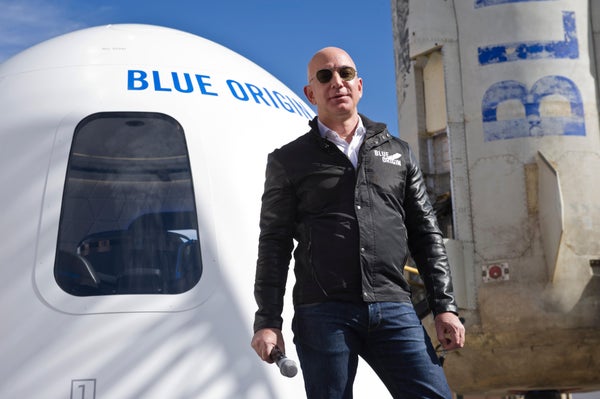
Jeff Bezos standing in front of Blue Origin spacecraft.

Blue Origin founder Jeff Bezos has announced he and his brother will be among the passengers of the aerospace company’s first crewed suborbital flight.

Join Our Community of Science Lovers!

Amazon.com and Blue Origin founder Jeff Bezos will fly on the first crewed flight of the New Shepard suborbital vehicle, the billionaire announced on Instagram on Monday (June 7).

The flight is scheduled for July 20, the 52nd anniversary of the Apollo 11 moon landing. The New Shepard capsule, which operates autonomously and does not need a pilot, will launch from Blue Origin’s West Texas facility. The flight will last approximately 11 minutes.

Bezos’ brother, Mark, will join the crew as well, the Instagram post noted. “Ever since I was five years old, I’ve dreamed of traveling to space,” Bezos wrote. “On July 20th, I will take that journey with my brother. The greatest adventure, with my best friend.”


On supporting science journalism

If you're enjoying this article, consider supporting our award-winning journalism by subscribing. By purchasing a subscription you are helping to ensure the future of impactful stories about the discoveries and ideas shaping our world today.


Another seat on the flight is currently being auctioned off to the highest bidder during a three-round process that will conclude on Saturday (June 12). Bids have already reached $2.8 million, according to the company; the winning sum will go to the company’s science and technology outreach foundation, Club for the Future.

The New Shepard vehicle can hold six passengers.

Blue Origin’s main competitor in suborbital tourism flights, Virgin Galactic, is also making strides toward flying its first paying customer. Its vehicle, the piloted VSS Unity space plane, has flown multiple times, including once with the company’s chief astronaut as a passenger.

Most recently, Virgin Galactic has sold tickets at $250,000, and in May, a company report indicated it was targeting a commercial flight as soon as next year.

Blue Origin’s fully reusable New Shepard system has flown 15 times during uncrewed tests. During the most recent flight, in April, company employees rehearsed the entrance and exit procedure, a milestone in advance of next month’s crewed flight.

“It’s an adventure,” Bezos said in a video posted with the announcement. “It’s a big deal for me.”

Copyright 2021 Space.com, a Future company. All rights reserved. This material may not be published, broadcast, rewritten or redistributed.

Meghan Bartels is a science journalist based in New York City. She joined Scientific American in 2023 and is now a senior reporter there. Previously, she spent more than four years as a writer and editor at Space.com, as well as nearly a year as a science reporter at Newsweek, where she focused on space and Earth science. Her writing has also appeared in Audubon, Nautilus, Astronomy and Smithsonian, among other publications. She attended Georgetown University and earned a master’s degree in journalism at New York University’s Science, Health and Environmental Reporting Program.

More by Meghan Bartels

SPACE.com is the premier source of space exploration, innovation and astronomy news, chronicling (and celebrating) humanity's ongoing expansion across the final frontier.

More by SPACE.com

It’s Time to Stand Up for Science

If you enjoyed this article, I’d like to ask for your support. Scientific American has served as an advocate for science and industry for 180 years, and right now may be the most critical moment in that two-century history.

I’ve been a Scientific American subscriber since I was 12 years old, and it helped shape the way I look at the world. SciAm always educates and delights me, and inspires a sense of awe for our vast, beautiful universe. I hope it does that for you, too.

If you subscribe to Scientific American, you help ensure that our coverage is centered on meaningful research and discovery; that we have the resources to report on the decisions that threaten labs across the U.S.; and that we support both budding and working scientists at a time when the value of science itself too often goes unrecognized.

In return, you get essential news, captivating podcasts, brilliant infographics, can't-miss newsletters, must-watch videos, challenging games, and the science world's best writing and reporting. You can even gift someone a subscription.

There has never been a more important time for us to stand up and show why science matters. I hope you’ll support us in that mission.

Thank you,

David M. Ewalt, Editor in Chief, Scientific American

Subscribe