John Glenn, First American in Orbit, Falls Ill in Ohio

The 95-year-old former astronaut and senator has been in hospital for more than a week

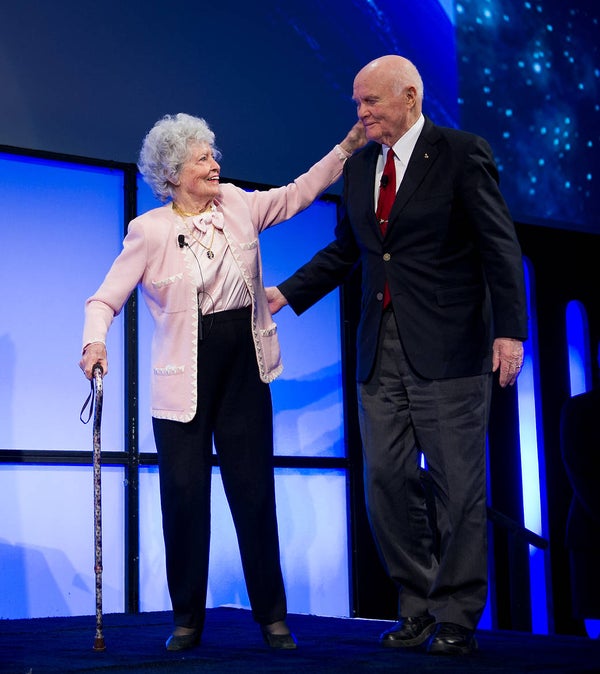
John Glenn and his wife Annie on February 20, 2012, during a ceremony at Ohio State University honoring the 50th anniversary of his historic orbital spaceflight, a first for the United States.

Join Our Community of Science Lovers!

Former NASA astronaut and U.S. senator John Glenn, the first American to orbit the Earth , has spent over a week in an Ohio hospital.

Glenn, now 95, was admitted to the James Cancer Hospital in Columbus, Ohio last week, the Associated Press reports. No information about his condition or diagnosis has been made public at this time. Communications officer Hank Wilson of Ohio State University's John Glenn College of Public Affairs said that Glenn doesn't necessarily have cancer, despite the hospital's title.

John Glenn became the first NASA astronaut to orbit the Earth in 1962 during his Friendship 7 mission, which was part of NASA's Project Mercury spaceflight program. After retiring from NASA and the U.S. Marine Corps in 1964 and 1965, consecutively, he worked as a business executive until being elected U.S. senator for Ohio in 1974, where he served until 1999. In 1998, Glenn returned to space, setting the record for the oldest space traveler when he flew on the space shuttle Discovery at the age of 77. [Photos: John Glenn, First American in Orbit]


On supporting science journalism

If you're enjoying this article, consider supporting our award-winning journalism by subscribing. By purchasing a subscription you are helping to ensure the future of impactful stories about the discoveries and ideas shaping our world today.


Earlier this year, the Port Columbus International Airport was renamed after Glenn. During a ceremony at the airport, Glenn noted that his eyesight had deteriorated from macular degeneration after a small stroke. 


Copyright 2016 SPACE.com, a Purch company. All rights reserved. This material may not be published, broadcast, rewritten or redistributed.

It’s Time to Stand Up for Science

If you enjoyed this article, I’d like to ask for your support. Scientific American has served as an advocate for science and industry for 180 years, and right now may be the most critical moment in that two-century history.

I’ve been a Scientific American subscriber since I was 12 years old, and it helped shape the way I look at the world. SciAm always educates and delights me, and inspires a sense of awe for our vast, beautiful universe. I hope it does that for you, too.

If you subscribe to Scientific American, you help ensure that our coverage is centered on meaningful research and discovery; that we have the resources to report on the decisions that threaten labs across the U.S.; and that we support both budding and working scientists at a time when the value of science itself too often goes unrecognized.

In return, you get essential news, captivating podcasts, brilliant infographics, can't-miss newsletters, must-watch videos, challenging games, and the science world's best writing and reporting. You can even gift someone a subscription.

There has never been a more important time for us to stand up and show why science matters. I hope you’ll support us in that mission.

Thank you,

David M. Ewalt, Editor in Chief, Scientific American

Subscribe