
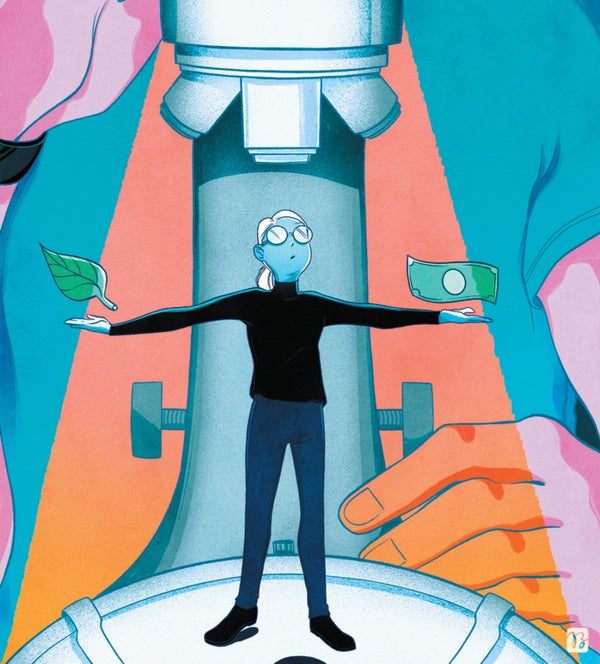
On April 1 Internet readers were treated to an announcement that appeared to come from Google CEO Sundar Pichai: “Today Google Stops Funding Climate Change Deniers.” It explained that Google—the world's preeminent information company—had for many years financed disinformation, but the COVID-19 crisis had made it take stock. Google executives would “stop our funding of organizations that deny or work to block action on climate change.”
The Twittersphere lit up as scientists and environmentalists praised the corporate giant for offering the private-sector leadership that has for the most part been missing on this issue. The Web site A Greener Google, where the announcement was published, received more than 100,000 hits, and at least one major news outlet—MarketWatch—reported the story.
Sadly, it was just an April Fools' Day joke staged by the activist group Extinction Rebellion, intended to expose the hypocrisy of companies that boast of green initiatives while supporting institutions that deny or downplay climate science. It was plausible in part because last year more than 1,000 Google employees asked their employer to stop funding these organizations, as have workers at Microsoft, Amazon and Facebook.
On supporting science journalism
If you're enjoying this article, consider supporting our award-winning journalism by subscribing. By purchasing a subscription you are helping to ensure the future of impactful stories about the discoveries and ideas shaping our world today.
Like all good satire, it addressed a real problem. In the past decade Google has contributed to more than a dozen groups that have worked to prevent action on climate change by promoting half-truths, misrepresentations and, sometimes, outright lies about climate research and scientists. These include the Competitive Enterprise Institute (CEI), the Texas Public Policy Foundation and the Cato Institute, all of which have a long paper trail of skepticism, if not outright hostility, toward climate science. CEI has been directly involved in personal attacks on scientists.
So why do large companies fund organizations that attack science? Nearly all leading corporations are part of trade groups that lobby for “pro-business” positions, such as lower taxes, and they typically turn a blind eye to these groups' other activities. Microsoft, for example, participated for years in the American Legislative Exchange Council (ALEC), which describes itself as dedicated to “limited government, free markets and federalism.” In 2011 it was revealed that ALEC had lobbied not only for pro-business initiatives but also for antidemocratic ones, such as restrictive voter ID requirements. Over the next few years a bevy of Fortune 500 companies, Microsoft included, began to withdraw support.
Since the New Deal, trade groups have tried to defend the prerogatives of the private sector by claiming that the federal government is a threat to freedom. In the 1980s and 1990s this transmogrified into an attack on science. As Erik Conway and I showed in our 2010 book, Merchants of Doubt, trade groups and libertarian think tanks resisted the findings on issues such as acid rain, the hole in the ozone layer, indiscriminate pesticide use and, above all, anthropogenic climate change—because these were problems that business created and that government was needed to fix. They denied reality to protect their ideology and economic interests.
We saw this on full display in recent months as many American conservatives refused to accept a significant role for government in containing the coronavirus pandemic. An extreme case is the governor of South Dakota. Even as COVID-19 reached her state and hundreds of workers became ill at a meat-packing plant, she refused to implement any form of state control. To be sure, stay-at-home orders do decrease personal freedom and hurt the economy. But governments that took early steps to contain the threat have done far better in protecting both personal liberty and their economies. In any case, “freedom” is an empty concept to the dead.
Sam Peinado of Extinction Rebellion told me in an e-mail that many Google employees thought the April Fools' announcement was real because it was “what they expected from their company.” And why not? Why shouldn't employees and customers expect corporate leaders in all sectors to disassociate themselves from organizations whose rigid ideologies and pursuit of self-interest have led us into an antiscientific dead end? COVID-19 has proved that denying science protects neither individuals nor the economy. It's time for corporate leaders to step up to the plate and reject the rejection of science.