If you're enjoying this article, consider supporting our award-winning journalism by subscribing. By purchasing a subscription you are helping to ensure the future of impactful stories about the discoveries and ideas shaping our world today.
In his monumental series Cosmos, astronomer Carl Sagan famously said that we humans are “made of star stuff.” Dying stars are continually filling the universe with heavy elements, and the energy of the cosmos sparked life into existence on this planet. After billions of years, plants began to harvest sunlight directly, converting solar into chemical energy, and therefore all human life feeds on the output of stars. Those same elements that streamed through the vacuum of space and coalesced in the core of Earth also, it seems, created the conditions under which life can survive.
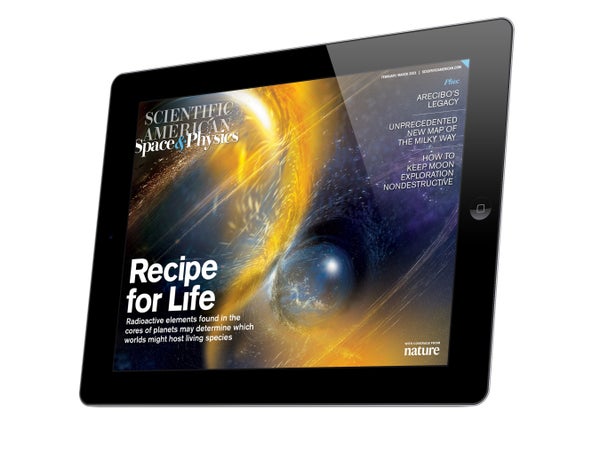
As writer Marcus Woo details in this issue’s cover story, certain radionuclides in exoplanets may be the signal to look for if we want to find alien life (see “Stellar Smashups May Fuel Planetary Habitability, Study Suggests”). An exciting potential extraterrestrial signal radiated to Earth last December, causing a media stir, as do all prospects of meeting our cosmic neighbors (see “Alien Hunters Discover Mysterious Signal from Proxima Centauri”). Indeed, if we find intelligent life in the universe, we will have a common heritage.
Subscribe to Support Independent Journalism
Great science journalism requires human expertise, time, effort and creativity. And it costs money. That’s why I and the journalists here at Scientific American hope you’ll join our community.
When you subscribe, you are supporting staff and freelance journalists who are passionate about telling science stories that are true, important and compelling. Our editors and reporters are often experts in their fields, which means they understand the nuances of big discoveries and can untangle the breakthroughs from the hype. With a subscription, you are also supporting rigorous fact-checking to ensure the words we publish are precise and accurate. And you’re supporting original illustrations, graphics and photos that bring you closer to an advanced laboratory, an ice sheet in Antarctica or a space mission in orbit. You’re helping us craft other types of high-quality journalism as well: Our newsletters are carefully written, edited and curated by staffers you have or will come to know and love. Our Science Quickly podcast is based on original reporting, collaboration with editors and scientists and exacting production.
Subscriptions keep this engine running so we can continue to deliver thoughtful, rigorous and independent science journalism to you. In an era of viral misinformation, this work is crucial. If you value what we do, I hope you’ll consider joining us as a subscriber
Thank you,
Jeanna Bryner, Editor in Chief, Scientific American