
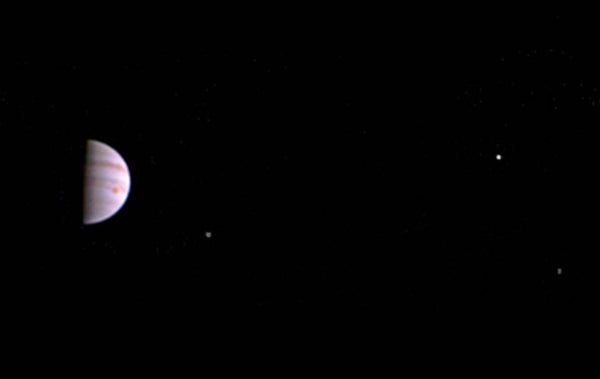
NASA's Juno probe has snapped its first image of Jupiter since going into orbit around the giant planet last week.
Juno captured the photo — which show Jupiter's famous Great Red Spot, some of its cloud belts and the three big Jovian moons Europa, Ganymede and Io — with its visible-light JunoCam instrument on Sunday (July 10).
At the time, Juno was about 2.7 million miles (4.3 million kilometers) from Jupiter, NASA officials said. [Photos: NASA's Juno Mission to Jupiter]
On supporting science journalism
If you're enjoying this article, consider supporting our award-winning journalism by subscribing. By purchasing a subscription you are helping to ensure the future of impactful stories about the discoveries and ideas shaping our world today.
"This scene from JunoCam indicates it survived its first pass through Jupiter's extreme radiation environment without any degradation and is ready to take on Jupiter," Juno principal investigator Scott Bolton, of the Southwest Research Institute in San Antonio, said in a statement today (July 12). "We can't wait to see the first view of Jupiter's poles."
Juno reached Jupiter on July 4 after a nearly five-year journey through deep space. The probe's science instruments were off at the time of arrival, to reduce complications during a crucial, 35-minute-long orbital-insertion burn. The Juno team began turning some instruments on July 6; JunoCam was powered up on Sunday, NASA officials said.
Juno is currently cruising away from the planet, toward the more distant parts of a highly elliptical, 53-day orbit.
"JunoCam will continue to take images as we go around in this first orbit," Juno co-investigator Candy Hansen, of the Planetary Science Institute in Tucson, Arizona, said in the same statement. "The first high-resolution images of the planet will be taken on Aug. 27, when Juno makes its next close pass to Jupiter."
The $1.1 billion Juno mission aims to study the magnetic and gravitational fields of Jupiter, as well as the gas giant's composition and internal structure. The probe's observations should help scientists understand how Jupiter, and the solar system in general, formed and evolved, mission team members have said.
Over the course of its mission, Juno will zip around Jupiter 37 times, scrutinizing the solar system's largest planet with nine different science instruments from as little as 2,600 miles (4,100 km) away. The vast majority of these loops will take 14, not 53 days; Juno will perform a 22-minute engine burn on Oct. 19 to shift into the two-week orbit.
Though scientists will study JunoCam's photos, the camera is not one of the probe's core science instruments; mission team members put it onboard to increase public engagement. All of JunoCam's images will be available on the mission's website, NASA officials said.
Juno's mission is currently scheduled to end in February 2018, with an international death dive into Jupiter's thick atmosphere.
Juno Spacecraft's July 4 Jupiter Arrival: Complete Mission Coverage
Jupiter Moons' Orbital Dance - Humans Have Never Seen This! | Video
Copyright 2016 SPACE.com, a Purch company. All rights reserved. This material may not be published, broadcast, rewritten or redistributed.