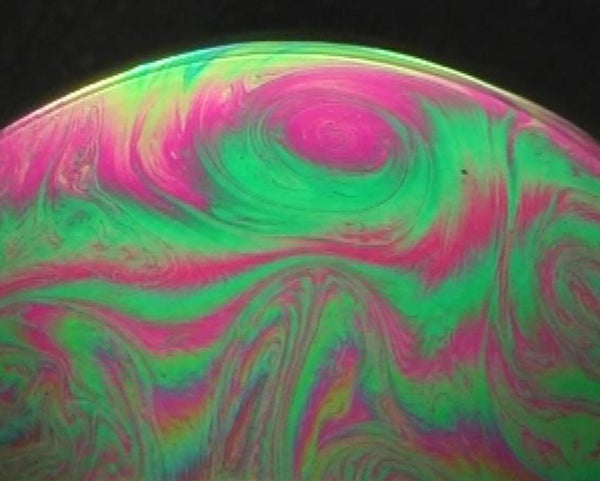
Researchers are bubbling over a new trick for whipping up mini-hurricanes that resemble the real kind, such as this sudsy replica of Jupiter's Great Red Spot.
F. Seychelles and H. Kellay
Join Our Community of Science Lovers!
On supporting science journalism
If you're enjoying this article, consider supporting our award-winning journalism by subscribing. By purchasing a subscription you are helping to ensure the future of impactful stories about the discoveries and ideas shaping our world today.
Researchers are bubbling over a new trick for whipping up mini-hurricanes that resemble the real kind, such as this sudsy replica of Jupiter's Great Red Spot. Scientists at the University of Bordeaux in France used a sophisticated straw--made of a tube of rubber attached to a pipette--to blow half-bubbles up to four inches (10 centimeters) wide on a soapy solution in a beaker. Next, they heated the solution and cooled the bubble on top, triggering single vortices. The tiny twisters meandered randomly like real hurricanes, they reported in a recent issue of Physical Review Letters. Although atmospheric hurricanes come about in a much different way, the team said the effect may minimize the toil and trouble of studying the influence of turbulence on real storms.
It’s Time to Stand Up for Science
If you enjoyed this article, I’d like to ask for your support. Scientific American has served as an advocate for science and industry for 180 years, and right now may be the most critical moment in that two-century history.
SciAm always educates and delights me, and inspires a sense of awe for our vast, beautiful universe. I hope it does that for you, too.
If you subscribe to Scientific American, you help ensure that our coverage is centered on meaningful research and discovery; that we have the resources to report on the decisions that threaten labs across the U.S.; and that we support both budding and working scientists at a time when the value of science itself too often goes unrecognized.