
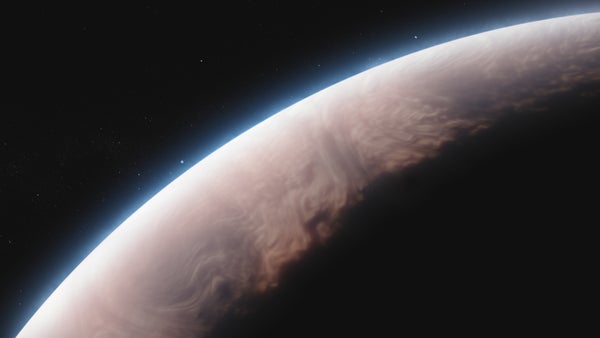
Thousand-mile-per-hour winds are blowing a hail of tiny quartz crystals through the silicate-enhanced, scorching hot atmosphere of a distant gas giant planet called WASP-17b, the James Webb Space Telescope (JWST) has found.
"We knew from Hubble [Space Telescope] observations that there must be aerosols — tiny particles making up clouds or haze — in WASP-17b's atmosphere, but we didn’t expect them to be made of quartz," Daniel Grant of the University of Bristol in the UK and leader of a new study on the discovery, said in a statement.
WASP-17b is an incredible world. Orbiting every 3.7 days at a distance of just 7.8 million kilometers (4.9 million miles) from its star, which sits 1,300 light years away from Earth, WASP-17b is so close to its stellar host that its dayside temperature rises to a staggering 1,500 degrees Celsius (approximately 2,700 degrees Fahrenheit). Because the atmosphere is so hot on this exoplanet, the world has actually expanded to about 285,000 kilometers (176,892 miles) across, which is just shy of twice the diameter of Jupiter. And that's despite WASP-17b having only about half of Jupiter’s overall mass. WASP-17b is one of the "puffiest" planets known — and its bloated atmosphere makes it a great target for the James Webb Space Telescope.
On supporting science journalism
If you're enjoying this article, consider supporting our award-winning journalism by subscribing. By purchasing a subscription you are helping to ensure the future of impactful stories about the discoveries and ideas shaping our world today.
Grant and fellow astronomers watched WASP-17b transit its star using the JWST’s Mid-Infrared Instrument (MIRI). As the exoplanet moved in front of its star from the JWST's point of view, MIRI detected starlight that was blocked by the puffy planet itself but partially absorbed by the world's atmosphere. Such measurements result in a so-called transmission spectrum, whereby certain wavelengths are blocked out by particular atmospheric molecules.
Like Jupiter, WASP-17b appeared to be mostly made from hydrogen and helium. In addition, MIRI detected carbon dioxide, water vapor and, at a wavelength of 8.6 microns, the absorption signature of pure quartz crystals. Combined with previous observations with the Hubble Space Telescope, these crystals are judged to be shaped like the same pointy, hexagonal prisms as quartz is on Earth, but just a meager 10 nanometers in size.
Quartz is a form of silicate, which are minerals rich in silica and oxygen. Silicates are exceptionally common — all the rocky bodies in the solar system are made from them, and silicates have previously been detected in the atmospheres of hot Jupiter exoplanets before. However, in those cases they had been more complex, magnesium-rich crystals of olivine and pyroxene.
"We fully expected to see magnesium silicates," said Bristol’s Hannah Wakeford. "But what we’re seeing instead are likely the building blocks of those, the tiny seed particles need to form the larger silicate grains we detect in cooler exoplanets and brown dwarfs."
WASP-17b is also tidally locked, meaning it always shows the same face to its star. As winds whip around the planet, carrying along the quartz nanoparticles, they form high-altitude hazes — essentially diffuse clouds of rock crystals — at the day–night termination zone. Those hazes then venture into the dayside, and are vaporized in the heat.
Grant explained how crystals of silicate come to be embedded in a planetary atmosphere in the first place.
"WASP-17b is extremely hot … and the pressure where the quartz crystals form high in the atmosphere is only about one-thousandth of what we experience on Earth’s surface," he said. "In these conditions, solid crystals can form directly from gas, without going through a liquid phase first."
The findings were published in October in Astrophysical Journal Letters.
Copyright 2023 Space.com, a Future company. All rights reserved. This material may not be published, broadcast, rewritten or redistributed.