
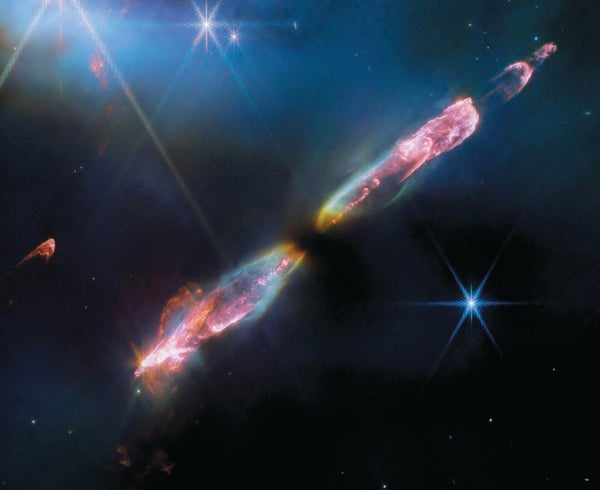
Shrouded in a turbulent knot of dust and gas, a fledgling star expels supersonic jets of material that stretch thousands of times the distance from Earth to the sun. This is the dramatic adolescence of HH 211, captured by the James Webb Space Telescope's Near-Infrared Camera and described in a study recently published in Nature.
Herbig-Haro objects, abbreviated “HH,” are formed when fast-moving matter spewed from protostars collides with surrounding dust and gas, producing shockwaves “rather like a bullet going through the air,” says the study's lead author Tom Ray, an astrophysicist at the Dublin Institute for Advanced Studies. These collisions excite the gas, releasing infrared light that JWST can observe.
In this image from the study, the red depicts excited hydrogen gas that rotates and vibrates at a few thousand kelvins, surrounded by green from carbon monoxide and blue from the young star's reflected light. The protostar itself sits in the rotating, dusty disk at the center of the image, where infrared radiation cannot escape because of the density of the dust and gas. Astrophysicists think the matter ejected by the wiggling jets slows the disk's spin, which allows the star to grow.
On supporting science journalism
If you're enjoying this article, consider supporting our award-winning journalism by subscribing. By purchasing a subscription you are helping to ensure the future of impactful stories about the discoveries and ideas shaping our world today.
Whereas older stars like our sun blast atoms, ions and molecules into space, HH 211 ejects mostly molecular matter. Such a surprising difference can help astrophysicists understand more about how stars grow out of this critical stage of development, Ray says.
“I could stare at this for a long time,” says astrophysicist Chin-Fei Lee of Taiwan's Academia Sinica, who has previously observed HH 211 using the ground-based telescope ALMA in Chile. ALMA has observed molecular outflows, but it cannot detect any high-temperature ionized material ejected by the jets. JWST did so and produced images with much higher resolution. “This is so impressive to me,” Lee says, “because we see the whole structure and the beautiful jet.”