
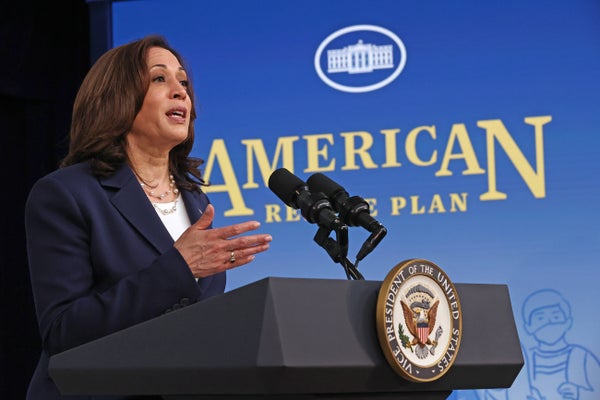
In her first major economic address, Vice President Kamala Harris yesterday outlined what the White House billed as a “vision of the future.”
Conspicuously absent: talk of climate change, which scientists and economists say will define the 21st century.
Harris’ speech fits a pattern of the Biden administration keeping climate in the background of its $2 trillion infrastructure plan, even as the White House touts its clean energy promises to an international audience. President Biden will press other countries in a Washington summit this week to increase their climate ambitions. He’s expected to direct attention to his infrastructure plan as a sign of U.S. commitment.
On supporting science journalism
If you're enjoying this article, consider supporting our award-winning journalism by subscribing. By purchasing a subscription you are helping to ensure the future of impactful stories about the discoveries and ideas shaping our world today.
Domestically, the White House has tended to focus on other issues. That could begin to change today, as Biden makes a “virtual tour” of a South Carolina electric bus and battery plant. But so far, climate has played only a bit role in the White House’s messaging.
Speaking at North Carolina’s Guilford Technical Community College, Harris pointed to the jobs Biden’s plan would create, the lead water pipes it would replace and the broadband it would install. Child and elder care were a major focus, as were training programs, apprenticeships and unionization.
“We are not going to take it slow, and we are not going to take it one step at a time. Nope. We are going to take a giant leap into the future,” Harris said in remarks livestreamed by the White House.
“Through our American Jobs Plan, a pipe fitter in Chicago could get a good job replacing lead pipes in their own city,” she said. “An electrician in Helena [Mont.] could get a good job laying broadband lines a few towns over. A forklift operator right here in Greensboro could get a good job fixing the road they drive on every day.”
But Harris didn’t talk about climate or clean energy until later, after the livestream ended, in a more low-profile tour of a Thomas Built Buses electric school bus factory. Biden’s plan aims to electrify at least 20% of the nation’s school buses.
Looking at the charging buses, Harris remarked that the electric vehicles save money on direct fuel costs as well as indirect costs from air pollution and associated diseases. A nearby bus idled in complete silence.
“This Thomas bus is a model for the country and the world on what is possible,” Harris said according to the White House pool.
To be sure, the White House has defended the American Jobs Plan’s climate measures in the face of Republican criticism, even as officials say everything’s up for negotiation.
School bus electrification was a focus of Harris’ as a senator and presidential candidate. And her tour yesterday signaled the administration’s commitment to its clean transportation proposal—one of the largest components of Biden’s plan ($174 billion) and a specific target of Republicans angling for a smaller bipartisan package.
Sens. Chris Coons (D-Del.) and John Cornyn (R-Texas) in a joint appearance on Fox News Sunday floated the idea of a $800 billion package focused on “core” infrastructure (E&E Daily, April 19).
Responding to that idea, White House press secretary Jen Psaki yesterday said the administration is listening to all proposals and “ideally” would find bipartisan consensus.
“The president’s bottom line here is that the only thing we cannot do is fail to invest in our nation’s infrastructure, rebuild our economy and create millions of jobs,” she said. “That’s the only piece he does not want to see us fail to do as a country.”
She later added that green jobs were “very central to the American Jobs Plan,” as well as Biden’s upcoming climate summit.
“When we talk about the climate summit and how we’re thinking about setting these targets and how we’re going to achieve them, a big part of that is investing in areas of our economy,” she said, “where we can create and build out industries and create jobs where we’re also able to meet our [climate] targets that we’ll set.”
Secretary of State Antony Blinken also spoke yesterday about the role of clean energy in U.S. competitiveness (see related story).
Reprinted from E&E News with permission from POLITICO, LLC. Copyright 2021. E&E News provides essential news for energy and environment professionals.