
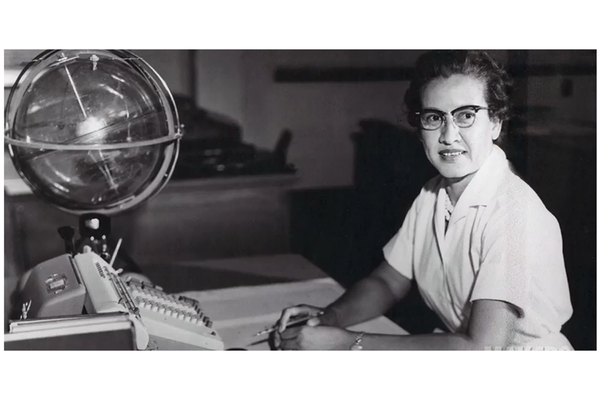
Katherine Johnson—a mathematician at NASA’s Langley Research Center in Virginia who helped make human spaceflight possible—celebrated 100 trips around the sun this weekend.
Johnson, one of NASA’s “human computers” whose calculations propelled NASA spacecraft to the stars, turned 100 on Aug. 26. Johnson is a retired NASA Langley mathematician who was integral to developing human spaceflight in America. Johnson, who was played by Taraji P. Henson in the feature film “Hidden Figures,” began her career at NASA on a team of black women who were also referred to as “human computers.” Like the other women in this group, Johnson broke down barriers as an African-American woman, despite anti-black prejudice.
“You are as good as anyone in this town, but you are no better than any of them,” says retired @NASA_Langley mathematician Katherine Johnson, who celebrates her 100th birthday today. Discover other life lessons from this trailblazer: https://t.co/FliCMfFYDt #Happy100Katherine pic.twitter.com/s0KIhj704W
— NASA (@NASA) August 26, 2018
On supporting science journalism
If you're enjoying this article, consider supporting our award-winning journalism by subscribing. By purchasing a subscription you are helping to ensure the future of impactful stories about the discoveries and ideas shaping our world today.
An unstoppable force and a role model to young African-American women, Johnson began her career at NASA’s Langley Research Center in 1953 after one of her relatives told her about open positions at an all-black West Area Computing section at the National Advisory Committee for Aeronautics’ (NACA’s) Langley laboratory. The lab was headed by Dorothy Vaughan, who came from West Virginia, just as Johnson did.
Today, retired @NASA_Langley mathematician Katherine Johnson makes her 100th trip around the Sun as she celebrates her birthday! Send her birthday wishes using #Happy100Katherine & learn about her calculations that launched @NASA_Astronauts to space ��: https://t.co/Iv2DqAt1LK pic.twitter.com/DVvVYnrupe
— NASA (@NASA) August 26, 2018
Johnson analyzed flight test data and even completed trajectory analysis for Freedom 7, America’s first human spaceflight. She co-authored the paper Determination of Azimuth Angle at Burnout for Placing a Satellite Over a Selected Earth Position, which detailed the equations that describe an orbital spaceflight where the craft’s landing position is specified. This was the first time that a woman received author credit for a research report in the Flight Research Division.

President Barack Obama presents former NASA mathematician Katherine Johnson with the Presidential Medal of Freedom on Nov. 24, 2015, during a ceremony in the East Room of the White House in Washington. Credit: Bill Ingalls NASA Flickr
Johnson’s most famous work, spotlighted in “Hidden Figures,” was for John Glenn’s orbital mission in 1962. The mission required a complicated worldwide communications network. The mission’s orbital calculations, which controlled the trajectory of the capsule for the mission, were programmed by a computer, but Glenn asked engineers to “get the girl”—referring to Katherine Johnson—to validate the calculations. She ran the same calculations by hand that the computer had run, and Glenn said, according to Johnson, “If she says they’re good, then I’m ready to go.”
Her legendary career with NASA lasted from 1953 to 1986.
Copyright 2018 SPACE.com, a Purch company. All rights reserved. This material may not be published, broadcast, rewritten or redistributed.