
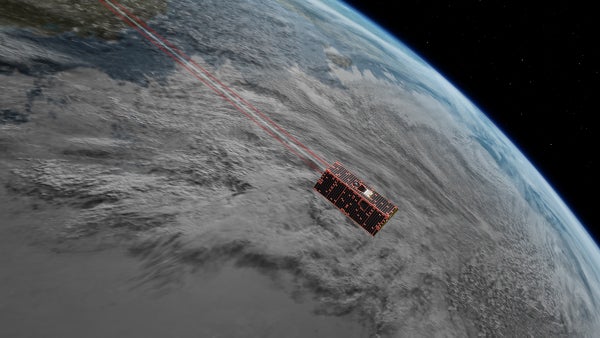
The Trump administration will launch a major climate science satellite mission later this month to track the movement of water around the planet.
The Gravity Recovery and Climate Experiment Follow-On satellites are scheduled to be launched as soon as May 19, NASA announced yesterday. They will monitor the polar ice caps, aquifer storage around the country and other key data related to climate change. The mission will also track changes in deep ocean currents, which drive climate change.
The GRACE missions have resulted in the most scientific findings and publications of any earth science mission in recent years, said Michael Watkins, director of NASA’s Jet Propulsion Laboratory. Almost every part of the world observed by GRACE has a story to tell. Because of GRACE, scientists now understand that the melting of the polar ice caps accounts for more than a third of sea-level rise globally, he said.
On supporting science journalism
If you're enjoying this article, consider supporting our award-winning journalism by subscribing. By purchasing a subscription you are helping to ensure the future of impactful stories about the discoveries and ideas shaping our world today.
“This is very important data, and it’s very important to how we understand our home planet and how it’s changing,” he said. The satellites can also track changes to the Earth’s crust, including the retreat of glaciers since the last ice age and the impact of large earthquakes, according to NASA.
The twin satellites of GRACE-FO will travel 137 miles apart, measuring the distance from one to the next with microwave signals. As they pass over the Earth, they will be slightly jostled by the gravitational pull of features like mountain ranges and underground aquifers. The satellites have extremely sensitive equipment—capable of tracking movements the width of a human hair—that will measure the distance and record changes, according to NASA.
The new satellites are an extension of the original GRACE mission, which ended its 15-year run last year. The new mission will provide an additional five years of data.
The Trump administration and congressional Republicans have repeatedly proposed cutting NASA’s climate satellite missions, but they have been restored by congressional appropriators during budget negotiations. The GRACE-FO mission will be the first major climate satellite launched since former Rep. Jim Bridenstine (R-Okla.) was confirmed as NASA administrator last month. Bridenstine has been an opponent of federal climate science in the past but has pledged to continue supporting the agency’s earth science research in his new role.
Late last year, the administration launched another climate satellite. The Joint Polar Satellite System-1 provides data essential to understanding how climate change is transforming the planet, including changes in Arctic sea ice and the ozone hole over Antarctica.
One key function of the GRACE satellites is tracking the mass of the polar ice sheets. The GRACE-FO mission is launching at a time when researchers are anxiously tracking major glaciers in Greenland and Antarctica to monitor their potential effect on sea-level rise.
The new satellites will provide long-term data on changes to water on the Earth’s surface, an important part of the climate record.
“The only way to know for sure whether observed multiyear trends represent long-term changes in mass balance is to extend the length of the observations,” said Frank Webb, project scientist at JPL.
Reprinted from Climatewire with permission from E&E News. E&E provides daily coverage of essential energy and environmental news at www.eenews.net.