
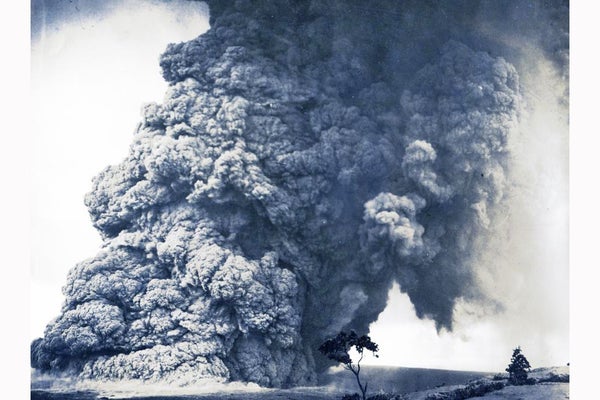
This week fissure number 18 opened on the east flank of Hawaii’s rumbling Kilauea Volcano, another in the set of rift-zone fractures advancing toward the Pacific coast. Several miles westward, nestled in Kilauea’s summit caldera, Halema‘uma‘u pit crater is evolving toward a hazardous scenario that reminds volcanologists like myself of a giant blowout that happened there in 1924.
That year a long-lived deep lake of bubbling molten basalt lava, a very popular tourist attraction, unexpectedly began to drop downward until it was no longer visible. This lava had been pushing against the pit crater’s vertical walls, holding them up. Without it, rocks of pebble to boulder size began to tumble into the deepening hole. High-velocity jets of steam, along with sulfurous volcanic fumes and small gritty rock debris, began to blow out from the pit in May of that year. Despite the danger, tourists continued to visit the upwind side of the deepening crater until violent steam explosions began to eject rocks large enough to injure and kill people—at least one person died. The largest projectile was about six feet in diameter and still sits south of Halema‘uma‘u along the current Chain of Craters Road as a mute reminder of how an apparently tame summit crater can become violent even with no new lava in evidence.
What is happening now at the crater is quite similar. A long-standing lava lake has just disappeared downward, creating a dark pit. Again, rocks from the newly exposed vertical walls are tumbling into the deepening hole as noxious fumes and grit rise up. With a potential natural shotgun loaded, the question scientists are trying to answer is: “Will the evolving situation today follow an explosive path similar to that of 1924?”
On supporting science journalism
If you're enjoying this article, consider supporting our award-winning journalism by subscribing. By purchasing a subscription you are helping to ensure the future of impactful stories about the discoveries and ideas shaping our world today.
The shotgun trigger, as it was 94 years ago, is believed to be groundwater. If the top of the retreating lava lake drops below the top of the surrounding groundwater table, water can flow onto the molten basalt, rapidly vaporize and produce powerful steam explosions capable of shooting large rocks out of Halema‘uma‘u to fall on anyone and anything within range of these expelled missiles.
There is cause for similar concern at Pu‘u ‘Ō‘ō, a vent on the east rift zone. Pu‘u ‘Ō‘ō has been erupting nearly continuously since 1982, and it is smaller than Halema‘uma‘u. But as the current set of fissure eruptions got underway, not far from Pu‘u ‘Ō‘ō a full pool of lava suddenly drained out of sight. It seems reasonable to many volcanologists—although we do not actually know what is going on underground here—to think Halema‘uma‘u, Pu‘u ‘Ō‘ō and the lower east rift zone are now all connected to a single reservoir of molten basalt. If so, all the eruptions along the lower east rift zone may have drained enough lava from the system to cause the loss of the lakes and ponds at both Halema‘uma‘u and Pu‘u ‘Ō‘ō. This raises the unsettling possibility that Pu‘u ‘Ō‘ō might also let loose steam blasts if groundwater enters the hot roots of the vent there.
As these precarious situations in all three places change on a daily basis, Tina Neal, the chief scientist at the U.S. Geological Survey’s Hawaiian Volcano Observatory, has been updating local officials and the public. (You can see frequent updates on Twitter, @USGSVolcanoes.) I worked at HVO from 1969 through 1972 when there were continuous eruptions at Kilauea, and I can appreciate the stress and excitement. We can hope for the best, says Tina—who is a good friend—but should always be prepared for the worst.