
Anybody who has taken an undergraduate psychology course or filled out one of those online tests is probably familiar with the “big five” personality traits: openness, conscientiousness, extraversion, agreeableness and neuroticism. For example, if you identify with the statement “I talk to a lot of different people at parties,” you might score high on extraversion. An individual's personality is thought to be fairly stable by adulthood, and the idea that it can be measured by just a handful of factors goes back at least a century.
But humans are not the only species whose personalities can be quantified along these lines; caregivers in zoos, sanctuaries and other captive environments commonly assess the personalities of animals, based on months or years spent observing and interacting with them. The specifics vary among species (for example, newts can be scored for their libidinousness and zebra finches and rhesus macaques for boldness), but the underlying notion that personality can be described by a small set of factors remains the same. Now research suggests that animals as widely divergent as chimpanzees and killer whales have surprisingly similar personality profiles.

Chimps share humans' “big five” personality traits, plus a sixth. Credit: K & K AMMAN Getty Images
On supporting science journalism
If you're enjoying this article, consider supporting our award-winning journalism by subscribing. By purchasing a subscription you are helping to ensure the future of impactful stories about the discoveries and ideas shaping our world today.
A team of researchers led by University of Edinburgh primatologist Drew Altschul amassed a quarter-century of chimp personality surveys. After passing data from 538 individual chimpanzees through a statistical model, Altschul and his team found that chimpanzee personality can be reduced to the same five traits applied to humans—plus a sixth known as dominance, which reflects the apes' “competitive prowess [and] social competence,” they write. The results were published online last October in eLife.
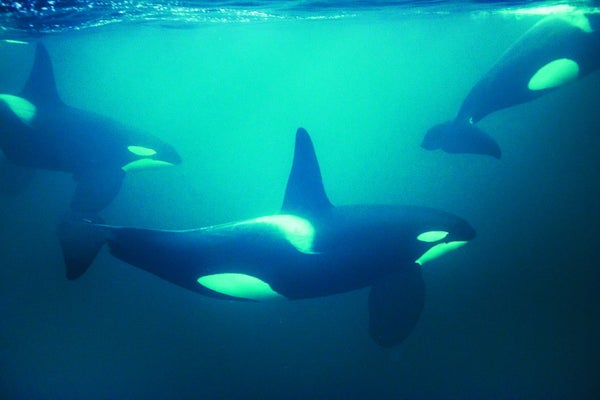
That chimpanzees and humans have similar personality profiles makes some sense, given that the two species are so closely related. But what about our more distant cousins? Primatologist Yulán Úbeda of the University of Girona in Catalonia was recently busy preparing a lecture for staffers at the Loro Parque zoo in the Canary Islands. She decided to see if any personality research had been conducted with killer whales, one of the zoo's main attractions. “Not only were there no studies of personality in killer whales,” but the only such cetacean studies she could find were limited to bottlenose dolphins, she says—and these did not utilize statistical techniques to reduce those personality metrics to a handful of factors. Úbeda asked trainers and researchers caring for 24 killer whales at three facilities in Spain and the U.S. to complete a survey originally designed to assess chimpanzee personality (though not the same survey Altschul used).
Killer whale personalities cluster into four traits, according to Úbeda's study, which was published last November in the Journal of Comparative Psychology. The first three are extraversion, dominance and carefulness; the fourth can be thought of as a combination of conscientiousness and agreeableness. When Úbeda compared these findings with the results of her own earlier research with chimpanzees, she found that the personality structures of the two species were quite similar (even though chimpanzee personality has six factors rather than four).
Given the differences in both habitat and neuroanatomy, not to mention the 94 million years that have passed since chimps and whales shared a common ancestor, Úbeda says she had not expected the two animals' personality traits to align so well with each other—or with those of humans. Still, “there's something about their social environment that has created this similarity in personality,” says Justin Gregg, senior research associate at the Dolphin Communication Project, who was not involved in the study. Indeed, he explains, chimps and killer whales are both known for complex cognition, large brains relative to body size, and cultural learning—also features of our own species—and have similar societal structures as well.
Understanding personality is not just an intellectual exercise. For humans there is a well-established link between personality and life span, and Altschul found a similar pattern for chimpanzees. “The core finding is that males who are higher in agreeableness will live longer than individuals who aren't as high,” he says. Chimps have a reputation for aggression, but individuals that are “sympathetic, helpful, sensitive, protective and gentle” are likely to lead longer lives, he explains. Altschul is careful to point out, however, that this is just a statistical correlation; the underlying relation between personality and longevity in the apes is not yet known.
Duke University psychologist Paul Costa, who was not involved in Altschul's study, highlights the significance of human culture in increased life span, noting the potential role of captivity in explaining the chimp results. “The most important personality dimension related to longevity in humans is conscientiousness, and this was not related in this chimpanzee population,” he says. The link in humans is most likely related to health behaviors. “People higher in conscientiousness exercise more, watch their diets, don't smoke and don't drink to excess,” he explains. But in captivity, “even the most lackadaisical chimps are given a good diet and regular medical treatments,” Costa adds, “whether they're conscientious or not.”