
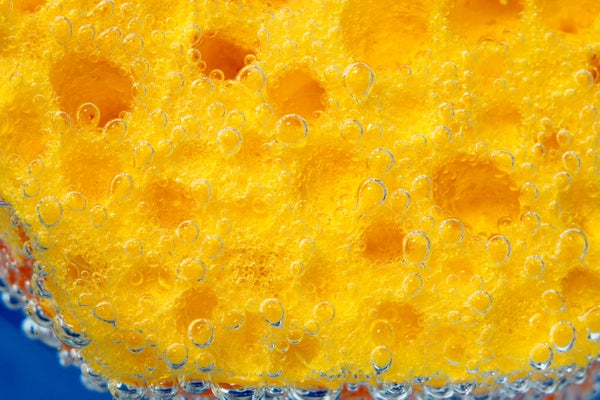
Your kitchen sponge is teeming with microbes. But repeated contact with food waste is not the only reason; a sponge’s unique structure plays a role, too. It could even inspire a new way to grow bacteria for research, according to a study in Nature Chemical Biology.
One of the biggest challenges microbiologists face is culturing bacteria species that will not readily grow in a laboratory. Some microbes are incredibly finicky, and scientists often have no idea what conditions these organisms need. “It’s kind of like trying to make pandas reproduce in the zoo,” says bacteriologist Trina McMahon of the University of Wisconsin–Madison, who was not involved in the new study.
Sponges could provide an answer. Bacteria are usually grown on petri dishes’ smooth, unpartitioned surfaces. But sponges are riddled with hollow pockets—which, crucially, are not uniform. “Imagine there are tiny rooms and bigger rooms,” says Lingchong You, a microbiologist at Duke University and senior author of the study. Some bacteria types depend on many other individuals for survival and need space to form large communities, but others require relative isolation so they are not killed by their neighbors. Sponges’ mix of larger and smaller chambers offers an ideal range.
On supporting science journalism
If you're enjoying this article, consider supporting our award-winning journalism by subscribing. By purchasing a subscription you are helping to ensure the future of impactful stories about the discoveries and ideas shaping our world today.
Although a sponge’s potential as a bacteria farm might seem intuitive, “actually demonstrating that experimentally is a challenging process,” You says. The researchers first modeled spongelike environments on a computer and found that varying chamber sizes would allow many different bacterial strains to thrive. Then they replicated these results in cellulose sponges.
“It’s rare to see both [scenarios] combined in such a nice way,” McMahon says. But she notes that You’s team focused on Escherichia coli strains that were lab-engineered to be either dependent on one another or self-sufficient—so she wonders if the sponge technique will work with other sensitive bacteria. “There is a limit, I think, to what you can do with those engineered strains,” she says.
Future experiments will show whether You’s purpose-built sponges can support wild microbes. In the meantime, he recommends sanitizing your kitchen sponge: “It’s probably not the cleanest item.”