
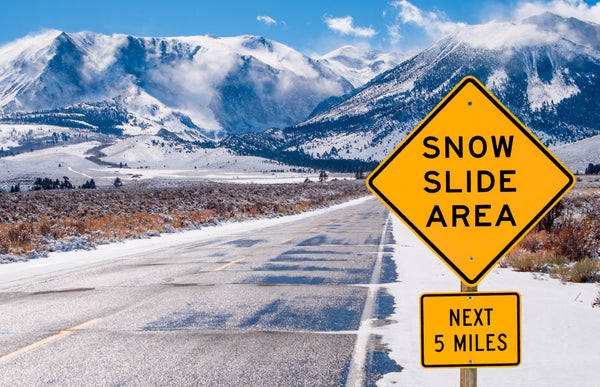
Most of the western U.S., including the Lake Tahoe region of California and Nevada, has had an exceptionally warm winter—breaking records in many areas. And that unseasonable warmth may have caused a disastrous avalanche at the area’s Castle Peak mountain that buried a group of skiers on Tuesday.
The weeks of warm weather may have caused the thin snow cover at high altitudes in the Lake Tahoe region to partially melt, creating an unstable base layer that was then covered by a dump of snow over the past few days, says climate scientist Daniel Swain of the California Institute for Water Resources. According to the National Weather Service, some parts of the area had three feet of snow in 24 hours, and it’s estimated that more than five feet of snow has fallen there since Sunday.
“There has been a very sudden switch from warm and dry to very heavy snowfall,” Swain says. “This was probably in the area where this avalanche occurred.”
On supporting science journalism
If you're enjoying this article, consider supporting our award-winning journalism by subscribing. By purchasing a subscription you are helping to ensure the future of impactful stories about the discoveries and ideas shaping our world today.
This combination of an unstable base below a thick layer of unconsolidated fresh snow is one of the most dangerous causes of snow avalanches in the mountains, Swain says. And it seems this led to the avalanche on Tuesday that trapped the skiers at Castle Peak, which is near the town of Truckee, Calif., and a few miles northwest of Lake Tahoe.
The bodies of eight skiers have been recovered, with a ninth person missing but presumed dead, according to news reports. Another six skiers with the group survived but had to be rescued by a vehicle called a snowcat because of the blizzardlike conditions.
David Reichel, executive director of the Sierra Avalanche Center, which issues forecasts for the Tahoe-Truckee area, says his group is monitoring the recent weakening of the snow surface. “We made several videos discussing these problematic layers over the last week or so,” he adds.
Many scientists expect rising temperatures from climate change to increase dangerous avalanches, Swain says. Though warming may suggest less snowfall, that’s not the entire picture. Lower altitudes are expected to see less snow, but higher elevations could actually see higher snowfalls as temperatures there remain below freezing but warm enough for there to be more moisture for storms.
“The influence of climate change on avalanches is currently under study, but … the likelihood of having these dry and warm conditions preceding a very heavy snowfall has increased in California,” Swain says.