
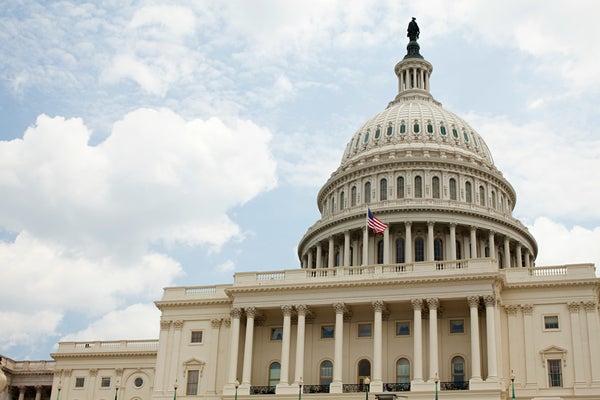
In a move that will mandate required federal safety assessments of chemicals found in everyday products from laundry detergent to toys, a June 7 U.S. Senate vote sends legislation to President Barack Obama for signature.
The President is expected within days to sign the measure, which marks Congress’s first major overhaul of a federal pollution control statute in a decade. The legislation will fundamentally change U.S. regulation of the products of the chemical industry, from commodity substances that have been in use for decades to novel commercial compounds discovered and developed by research chemists.
“Most Americans believe that when they buy a product at the hardware store or the grocery store, that product has been tested and determined to be safe. But that isn’t the case,” explains Sen. Tom Udall (D-N.M.), who championed the legislation.
On supporting science journalism
If you're enjoying this article, consider supporting our award-winning journalism by subscribing. By purchasing a subscription you are helping to ensure the future of impactful stories about the discoveries and ideas shaping our world today.
Residents of the U.S. are exposed to hundreds of commercially produced chemicals, he points out. “We carry them around with us in our bodies, even before we’re born. Some are known carcinogens; others are highly toxic. But we don’t know the full extent of how they affect us because they have never been tested,” Udall says.
The measure mandates that the Environmental Protection Agency assess the safety of chemicals in commerce. It also gives EPA new authority to require chemical manufacturers to test their products for possible risks to human health and the environment. Currently, EPA is caught in a dilemma: It must document that a substance may pose a risk before it can demand that chemical makers conduct toxicity or exposure tests.
The pending new law will modernize a somewhat obscure statute, the 1976 Toxic Substances Control Act (TSCA), which has faced growing criticism for years. On paper, this law gives EPA authority to restrict or ban chemicals that pose risks to human health or the environment. But in practice, the agency hasn’t been able to regulate chemicals in commerce since a court ruling in 1991 overturned EPA’s ban of asbestos, a known human carcinogen. TSCA requires the agency to select the “least burdensome alternative” when regulating, the court found, giving regulated industries wide berth in attacking whatever option EPA chooses with ideas of their own.
Amid consumers’ increasing skepticism about the safety of chemicals in products they buy, the chemical industry in recent years joined with environmental and health activists in calling for Congress to revise TSCA.
“This is almost unprecedented where you have an environmental legislation where you have this breadth and depth of support,” Cal Dooley, CEO of the American Chemistry Council, a chemical industry trade association, told reporters after the Senate’s voice vote in favor of the legislation. The House of Representatives passed the bill (H.R. 2576) in a 403-12 vote on May 24.
“After four decades of living under a stagnant chemical safety law, I am so very glad to have passed a law that strengthens our country’s international competitiveness, provides desperately needed regulatory certainty for industry, and mandates that the federal government use better science and provide more transparency,” says Sen. David Vitter (R-La.). Vitter, whose state is home to a sizable chunk of the U.S. chemical industry, was a linchpin in brokering the bipartisan deal now headed to the White House.
A number of environmental groups support the legislation for making long-needed revisions to the chemical law. Other activists criticize it for not being protective enough of people’s health.
This article is reproduced with permission from Chemical & Engineering News (© American Chemical Society). The article was first published on June 8, 2016.