
One of the biggest stories in science has been quietly playing out in the world of abstract mathematics. Over the course of 2024 researchers fulfilled a decades-old dream when they unveiled a proof of the geometric Langlands conjecture, a key piece of a group of interconnected problems called the Langlands program. The proof—a gargantuan effort—validates the intricate and far-reaching Langlands program, which is often hailed as the grand unified theory of mathematics but remains largely unproven. Yet the work’s true impact might lie not in what it settles but in the new avenues of inquiry it reveals.
“It’s a huge triumph. But rather than closing a door, this proof throws open a dozen others,” says David Ben-Zvi of the University of Texas at Austin, who was not involved with the work.
Proving the geometric Langlands conjecture has long been considered one of the deepest and most enigmatic pursuits in modern mathematics. Ultimately it took a team of nine mathematicians to crack the problem, in a series of five papers spanning almost 1,000 pages. The group was led by Dennis Gaitsgory of the Max Planck Institute for Mathematics in Germany and Sam Raskin of Yale University, who completed his Ph.D. with Gaitsgory in 2014.
On supporting science journalism
If you're enjoying this article, consider supporting our award-winning journalism by subscribing. By purchasing a subscription you are helping to ensure the future of impactful stories about the discoveries and ideas shaping our world today.
The magnitude of their accomplishment was quickly recognized by the mathematical community: in April 2025 Gaitsgory received the $3-million Breakthrough Prize in Mathematics, and Raskin was awarded a New Horizons prize for promising early-career mathematicians. Like many landmark results in mathematics, the proof promises to forge bridges between different areas, allowing the tools of one domain to tackle intractable problems in another. All told, it’s a heady time for researchers in these fields.
“It gives us the strongest evidence yet that something we’ve believed in for decades is true,” Ben-Zvi says. “Now we can finally ask: What does it really mean?”
The hole story
The Langlands program traces its origins back 60 years to the work of a young Canadian mathematician named Robert Langlands, who set out his vision in a handwritten letter to influential French mathematician André Weil. Over the decades the program attracted increasing attention from others in the field, who marveled at how all-encompassing it was. That feature led Edward Frenkel of the University of California, Berkeley, who has made key contributions to the geometric side, to call it the grand unified theory of mathematics.
Langlands’s aim was to connect two very separate major branches of mathematics: number theory (the study of integers) and harmonic analysis (the study of the way complicated signals or functions break down into simple waves). A special case of the Langlands program is the epic proof of Fermat’s last theorem—that no three positive integers a, b and c can satisfy the equation an + bn = cn if n is an integer greater than 2—published in 1995 by Andrew Wiles, then at Princeton University.
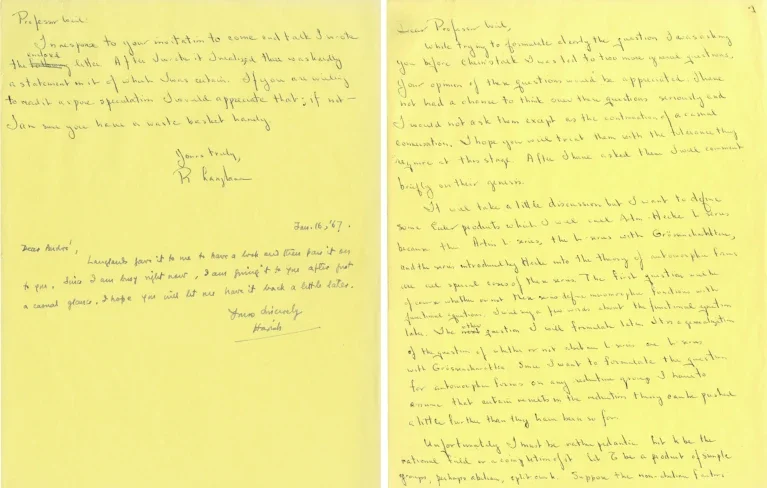
Robert Langlands discussed his ideas in a letter to André Weil in 1967. On the cover page to the letter (left), Langlands says, “If you are willing to read it as pure speculation I would appreciate that; if not — I am sure you have a waste basket handy."
Shelby White and Leon Levy Archives Center, Institute for Advanced Study
The geometric Langlands conjecture was first developed in the 1980s by Vladimir Drinfeld, then at the B. Verkin Institute for Low Temperature Physics and Engineering in Ukraine. Like the original or arithmetic form of the Langlands conjecture, the geometric conjecture also makes a type of connection: it suggests a correspondence between two different sets of mathematical objects. Although the fields linked by the arithmetic form of Langlands are separate mathematical “worlds,” the differences between the two sides of the geometric conjecture are not so pronounced. Both concern properties of Riemann surfaces, which are “complex manifolds”—structures with coordinates that are complex numbers (with real and imaginary parts). These manifolds can take the form of spheres, doughnuts, or pretzel-like shapes with two or more holes.
Many mathematicians strongly suspect that the “closeness” of the two sides means the proof of the geometric Langlands conjecture could eventually offer some traction for furthering the arithmetic version, in which the relationships are more mysterious. “To truly understand the Langlands correspondence, we have to realize that the ‘two worlds’ in it are not that different—rather they are two facets of one and the same world,” Frenkel says. “Seeing this unity requires a new vision, a new understanding. We are still far from it in the original formulation. But the fact that, for Riemann surfaces, the two worlds sort of coalesce means that we are getting closer to finding this secret unity underlying the whole program,” he adds.
One side of the geometric Langlands conjecture concerns a characteristic called a fundamental group. In basic terms, the fundamental group of a Riemann surface describes all the distinct ways in which loops can be tied around it. With a doughnut, for example, a loop can run horizontally around the outer edge or vertically through the hole and around the outside. The geometric Langlands deals with the “representation” of a surface’s fundamental group, which expresses the group’s properties as matrices (grids of numbers).
The other side of the geometric Langlands program has to do with special kinds of “sheaves.” These tools of algebraic geometry are rules that allot vector spaces (in which vectors—arrows—can be added and multiplied) to points on a manifold in much the same way as a function describing a gravitational field, say, can assign numbers for the strength of the field to points in standard three-dimensional space.
Bridgework in progress
Work on bridging this divide began back in the 1990s. Using earlier work on Kac-Moody algebras, which “translate” between representations and sheaves, Drinfeld and Alexander Beilinson, both now at the University of Chicago, described how to build the right kind of sheaves to make the connection. Their paper, which is nearly 400 pages long, has never been formally published. Gaitsgory, together with Dima Arinkin of the University of Wisconsin–Madison, made this relationship more precise in 2012; then, working alone, Gaitsgory followed up with a step-by-step outline of how the geometric Langlands might be proved.
“The conjecture as such sounds pretty baroque—and not just to outsiders,” Ben-Zvi says. “I think people are much more excited about the proof of geometric Langlands now than they would have been a decade ago because we understand better why it’s the right kind of question to ask and why it might be useful for things in number theory.”
One of the most immediate consequences of the new proof is the boost it provides to research on “local” versions of the different Langlands conjectures, which zoom in on particular objects in the “global” settings. In the case of the geometric Langlands program, for example, the local version is concerned with the properties of objects associated with disks around points on a Riemann surface—rather than the whole manifold, which is the domain of the global version.
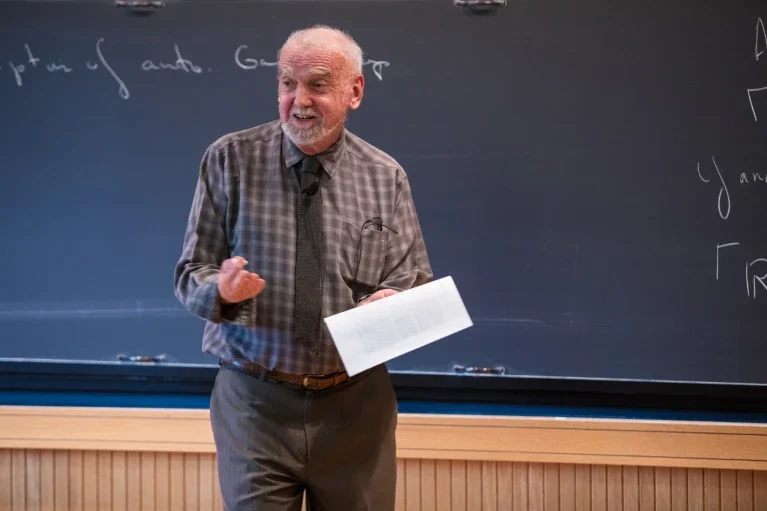
Robert Langlands in 2016.
Dan Komoda/Institute for Advanced Study
Peter Scholze of the Max Planck Institute for Mathematics has been instrumental in forging connections between the local and global Langlands programs. But initially even he was daunted by the geometric side.
“To tell the truth,” Scholze says, “until around 2014, the geometric Langlands program looked incomprehensible to me.” That changed when Laurent Fargues of the Institute of Mathematics of Jussieu in Paris proposed a reimagining of the local arithmetic Langlands conjectures in geometric terms. Working together, Scholze and Fargues spent seven years showing that this strategy could help mathematicians make progress in proving a version of the local arithmetic Langlands conjecture concerning the p-adic numbers, which involve the primes and their powers. They connected it to the global geometric version that the team led by Gaitsgory and Raskin later proved.
The papers by Scholze and Fargues built what Scholze describes as a “wormhole” between the two areas, allowing methods and structures from the global geometric Langlands program to be imported into the local arithmetic context. “So I’m really happy about the proof,” Scholze says. “I think it’s a tremendous achievement and am mining it for parts.”
Quantum connection
According to some researchers, one of the most surprising bridges built by the geometric Langlands program is to theoretical physics. Since the 1970s, physicists have explored a quantum analogue of a classical symmetry: that swapping electric and magnetic fields in Maxwell’s equations, which describe how the two fields interact, leaves the equations unchanged. This elegant symmetry underpins a broader idea in quantum field theory known as S-duality.
In 2007 Edward Witten of the Institute for Advanced Study (IAS) in Princeton, N.J., and Anton Kapustin of the California Institute of Technology were able to show that S-duality in certain 4D gauge theories—a class of theories that includes the Standard Model of particle physics—possesses the same symmetry that appears in the geometric Langlands correspondence. “Seemingly esoteric notions of the geometric Langlands program,” the pair wrote, “arise naturally from the physics.”
Although their theories include hypothetical particles called superpartners that have never been observed, their insight suggests that geometric Langlands is not just a rarefied idea in pure mathematics; instead it can be seen as a shadow of a deep symmetry in quantum physics. “I do think it is fascinating that the Langlands program has this counterpart in quantum field theory,” Witten says. “And I think this might eventually be important in the mathematical development of the Langlands program.”
Among the first to take that possibility seriously was Minhyong Kim, director of the International Center for Mathematical Sciences in Edinburgh. “Even simple-sounding problems in number theory—like Fermat’s last theorem—are hard,” he says. One way to make headway is by using ideas from physics, such as those in Witten and Kapustin’s work, as a kind of metaphor for number-theoretic problems, such as the arithmetic Langlands conjecture. Kim is working on making these metaphors more rigorous. “I take various constructions in quantum field theory and try to cook up precise number-theoretic analogues,” he says.
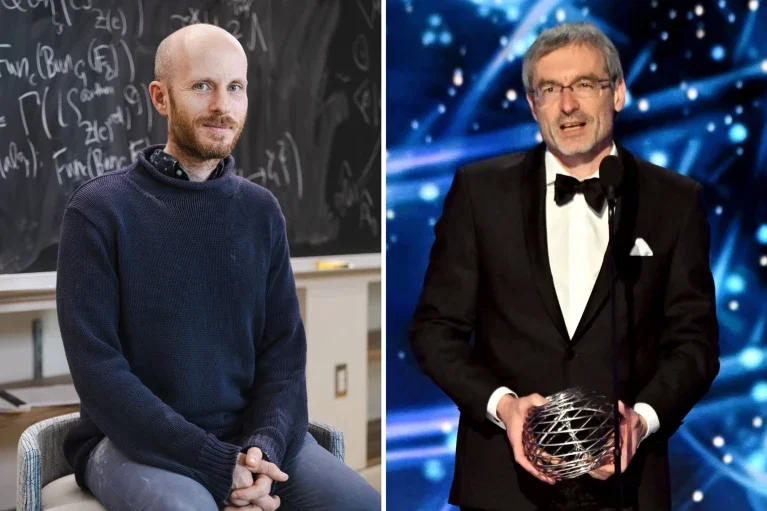
Sam Raskin (left) and Dennis Gaitsgory led the team that proved the geometric Langlands conjecture.
Dan Renzetti/Yale University, Lester Cohen/Getty Images for Breakthrough Prize
Ben-Zvi, together with Yiannis Sakellaridis of Johns Hopkins University and Akshay Venkatesh of IAS, is similarly seeking inspiration from theoretical physics, with a sweeping project that seeks to reimagine the whole Langlands program from the perspective of gauge theory.
Witten and Kapustin studied two gauge theories connected by S-duality, meaning that although they look very different mathematically, the theories are equivalent descriptions of reality. Building on this work, Ben-Zvi and his colleagues are investigating how charged materials behave in each theory, translating their dual descriptions into a network of interlinked mathematical conjectures.
“Their work really stimulated a lot of research, especially in the number-theory world,” Raskin says. “There’s a lot of people who are working in that circle of ideas now.”
One of their most striking results concerns a two-way relation between quite different mathematical objects called periods and L-functions. (The Riemann hypothesis, considered perhaps the most important unsolved problem in mathematics, is focused on the behavior of a type of L-function.) Periods are a part of harmonic analysis, whereas L-functions are from the realm of number theory—the two sides of Langlands’s original conjectures. Through the lens of physics, however, Ben-Zvi and his colleagues showed that the relation between periods and L-functions also mirrors that of the geometric program.
Hunting deeper truth
Many mathematicians are confident that the proof of the geometric conjecture will stand, but it will take years to peer-review the papers setting it out, which have all been submitted to journals. Gaitsgory, however, is already pushing forward on several fronts.
For instance, the existing proof addresses the “unramified” case, in which the terrain around points on the Riemann surface is well behaved. Gaitsgory and his collaborators are now hoping to extend their results to the more intricate, ramified case by accounting for more complex behavior around points, as well as for singularities or “punctures” in the surface.
To that end, they are extending their work to the local geometric Langlands conjecture to understand in more detail what happens around a single point—and collaborating with, among others, Jessica Fintzen of the University of Bonn in Germany.
“This result opens the door to a whole new range of investigations—and that’s where our interests start to converge, even though we come from very different worlds,” Fintzen says. “Now they’re looking to generalize the proof, and that’s what’s drawing me deeper into the geometric Langlands. Somehow the proof’s the beginning and not the end.”
Fintzen studies the representations of p-adic groups—groups of matrices in which the entries are p-adic numbers. She constructs the matrices explicitly—essentially, deriving a recipe for writing them down—and this seems to be the kind of local information that must be incorporated into the global geometric case to ramify it, Gaitsgory says.
What began as a set of deep conjectures linking abstract branches of mathematics has evolved into a thriving, multidisciplinary effort that stretches from the foundations of number theory to the edges of quantum physics. The Langlands correspondence might not yet be the grand unified theory of mathematics, but the proof of its geometric arm is a nexus of ideas that will probably shape the field for years to come.
“The Langlands correspondence points to much deeper structures in mathematics that we’re only scratching the surface of,” Frenkel says. “We don’t really understand what they are. They’re still behind the curtains.”
This article is reproduced with permission and was first published on July 16, 2025.