
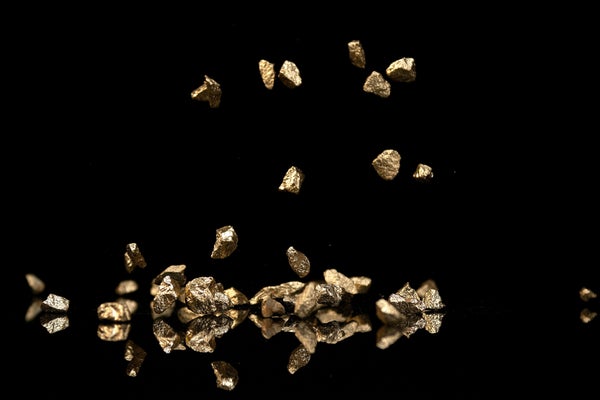
The dream of seventeenth-century alchemists has been realized by physicists at the Large Hadron Collider (LHC), who have turned lead into gold — albeit for only a fraction of a second and at tremendous cost.
The not-so-mysterious transmutation happened at CERN, Europe’s particle-physics laboratory, near Geneva, Switzerland, where the multi-billion-dollar LHC smashes together ions of lead for a portion of each experimental run.
Early chemists hoped to turn abundant lead into precious gold. But differences in proton number between the elements (82 for lead and 79 for gold) made that impossible by chemical means.
On supporting science journalism
If you're enjoying this article, consider supporting our award-winning journalism by subscribing. By purchasing a subscription you are helping to ensure the future of impactful stories about the discoveries and ideas shaping our world today.
CERN researchers achieved the feat by aiming beams of lead at each other, travelling at close to the speed of light. The ions occasionally glance past each other, rather than hit head on. When this happens, the intense electromagnetic field around an ion can create a pulse of energy that triggers an oncoming lead nucleus to eject three protons — turning it into gold.
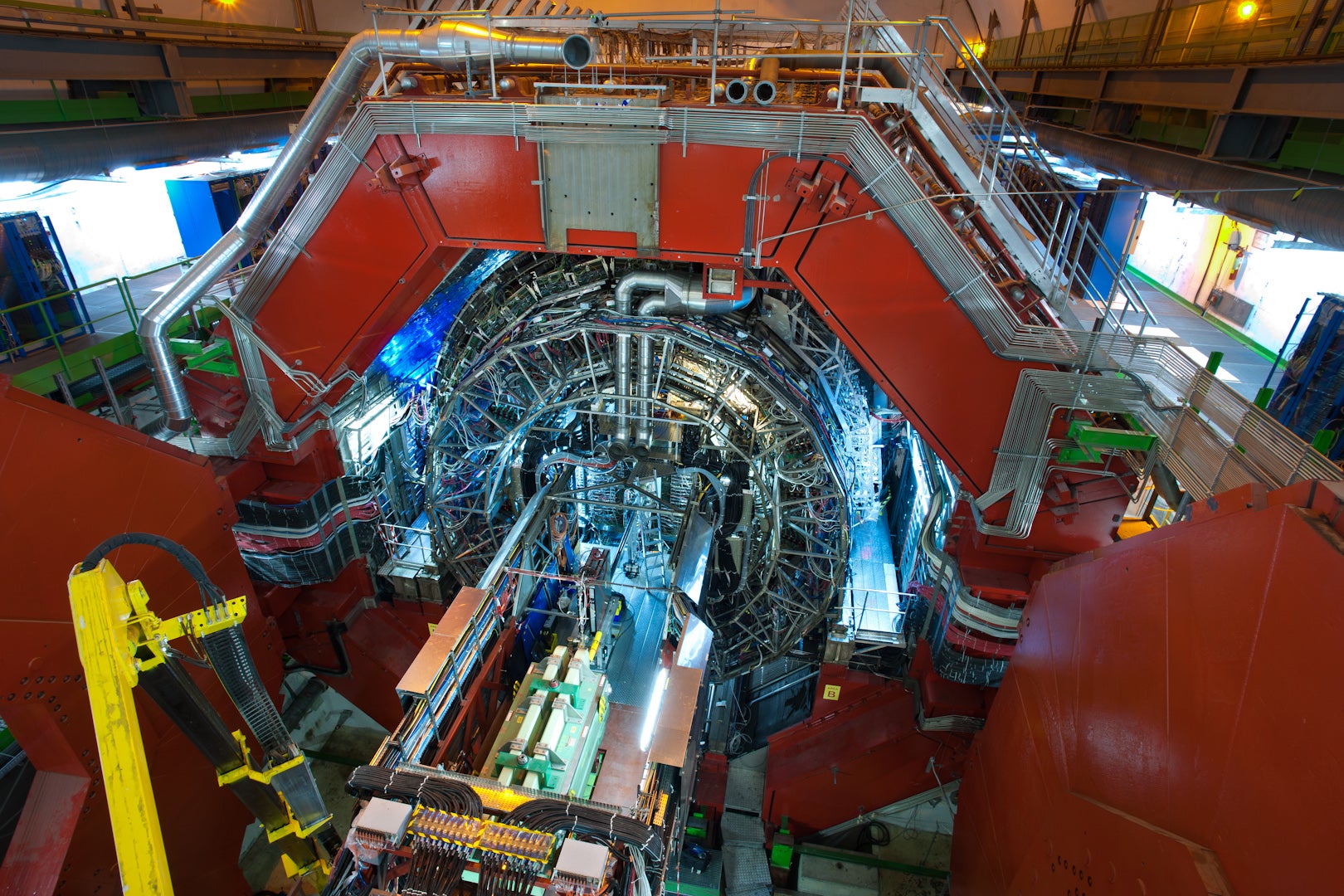
The ALICE detector at CERN.
CERN
The LHC’s ALICE experiment filtered out these instances of transmutation from the wider collision debris. In an analysis published on 7 May in Physical Review Journals, the team calculated that between 2015 and 2018, collisions at the LHC created 86 billion gold nuclei — around 29 trillionths of a gram. Most of the unstable, fast-moving gold atoms would have lasted around 1 microsecond before smashing into experimental apparatus or breaking into other particles.
Gold is being made any time lead beams are collided at the LHC, but ALICE is the only experiment with the detector set up to spot this process. The analysis “is the first to systematically detect and analyse the signature of gold production at the LHC experimentally”, says Uliana Dmitrieva, a physicist and member of the ALICE collaboration.
Another CERN accelerator called the SPS observed lead changing into gold from 2002 to 2004, says Jiangyong Jia, a physicist at Stony Brook University in New York. But the latest experiments are at higher energy, have a much higher probability of creating gold and make for much cleaner observations, he adds.
CERN researchers have no plans to take up gold-making as a side hustle, but say that better understanding how photons can change nuclei will help them to improve the LHC’s performance. “Understanding such processes is crucial for controlling beam quality and stability,” says Jia.
This article is reproduced with permission and was first published on May 9, 2025.