
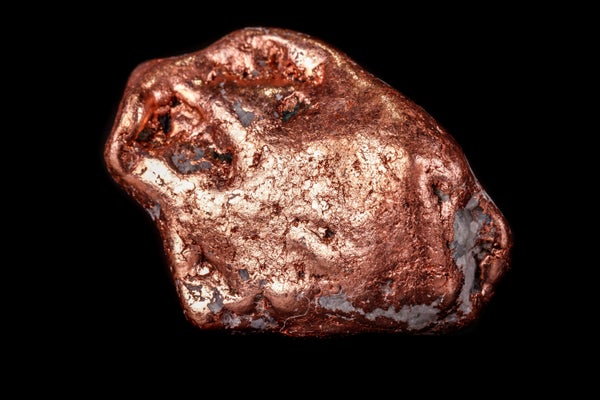
Copper surfaces kill microbes that come into contact with them in a matter of hours. A new technique makes the familiar metal even deadlier—by zapping it with lasers.
Bacteria “are becoming more aggressive and resistant to therapeutics; it's the same thing for viruses,” says Rahim Rahimi, a materials engineer at Purdue University and senior author of a paper on the new process, published in April in Advanced Materials Interfaces. “There is a lot of interest in how to create surfaces that actually, on contact with the bacterium or the virus, immediately kill the pathogen” because this “eliminates the spread of that pathogen into the environment.” (The new research focused particularly on bacteria.)
Copper is a good candidate for such surfaces: humans have been taking advantage of its bacteria-slaying properties for at least 8,000 years. People in some Bronze Age civilizations let their drinking water rest in copper vessels to avoid disease, says Michael Schmidt, a microbiologist at the Medical University of South Carolina, who was not involved in the new research. Copper's germ-destroying power, he explains, comes from its ability to conduct electricity. When a microbe touches a metal surface, the substance carries electrons away from the microbe's cellular membrane. This reaction sets off a chemical process that ultimately forces open the organism's pores and destroys it.
On supporting science journalism
If you're enjoying this article, consider supporting our award-winning journalism by subscribing. By purchasing a subscription you are helping to ensure the future of impactful stories about the discoveries and ideas shaping our world today.
To enhance the process, Rahimi's team hit a copper sample with laser light for a few milliseconds, thereby creating nanoscale pores in the flat metal and increasing its surface area. “They've effectively taken a prairie and made Manhattan,” Schmidt says, noting that the added vertical structures “increased the amount of ‘square footage' ... available to kill microbes.” The bumpy surface also made the copper cling more strongly to water—and thus to any bacteria within it.
The researchers tested this newly rugged terrain by placing several bacterial strains, including Escherichia coli and a drug-resistant Staphylococcusaureus strain, on both flat and laser-treated pieces of copper. As soon as the cells hit the textured metal, their membranes began to suffer damage; that surface completely eradicated the bacteria, in some cases much more quickly than the untreated one. The surface killed some microbes immediately on contact and took from 40 minutes to two hours to wipe out a full colony, depending on the species and concentration.
The laser treatment could also work with other metals, including titanium, which is often used for surgical implants, Rahimi says. He points out that all types of metals display some antimicrobial properties, although titanium, which has little conductivity, kills germs much more slowly than highly conductive ones such as copper. Applying the laser technique, he says, “could actually boost up the antimicrobial properties of that targeted metal.”