
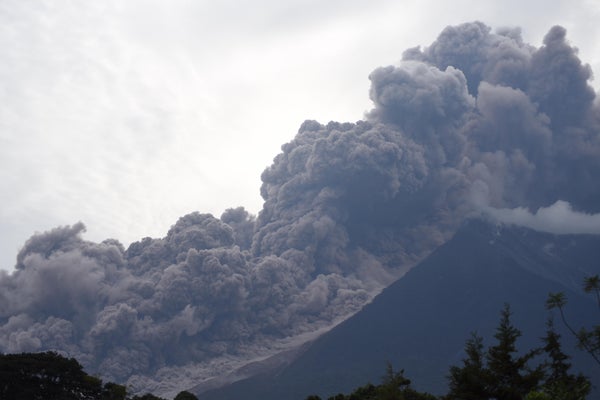
A volcanic eruption in Guatemala that spewed out ashy plumes and scorching-hot lava on Sunday (June 3) has killed at least 33 people, according to news reports.
The volcano, known as Volcán de Fuego (Volcano of Fire), erupted just before noon local time. Lava as hot as 1,300 degrees Fahrenheit (700 degrees Celsius) sped down the volcano’s slopes and into the surrounding villages, covering roads, burning houses and hampering rescue efforts, Eddy Sánchez, director of the country’s seismology and volcanology institute, told the Associated Press (AP).
Among the dead are two children—a brother and sister who were burned to death as they watched the eruption from a bridge, Sergio Cabanas, the country’s national disaster coordinator, told the AP. [Amazing Images: Volcanoes from Space]
On supporting science journalism
If you're enjoying this article, consider supporting our award-winning journalism by subscribing. By purchasing a subscription you are helping to ensure the future of impactful stories about the discoveries and ideas shaping our world today.
Volcán de Fuego is a stratovolcano, meaning its 12,346-foot-tall (3,763 meters), mountainous peak is made up of layers of lava, volcanic rock fragments called tephra and pyroclastic flows—a dense mix of ash, lava fragments and gases that rocket out of volcanoes at high speeds.
The volcano is part of the Central American Volcanic Arc, which extends about 930 miles (1,500 kilometers) along the Pacific coast of Central America. These volcanoes sit on the western edge of the Caribbean tectonic plate, along an active subduction zone. In this case, the adjacent Cocos Plate is subducting under the Caribbean Plate, according to a 2017 report from the Complutense University of Madrid.
Yesterday’s eruption is the deadliest that Guatemala has experienced since 1902, when the country’s Santa María volcano killed thousands of people, according to the BBC. However, Volcán de Fuego has erupted continuously since 1999, and it commonly has dozens of small explosive eruptions every day, according to the Guatemalan government. This past February, the volcano had a slightly larger eruption that spewed out ash reaching 1.1 miles (1.7 km) high, the BBC said.
Nearly 50 people are still missing after yesterday’s eruption, which also injured at least 20 victims and prompted the evacuation of more than 3,200 people, the AP reported. Today, rescuers are using heavy machinery and shovels to search for survivors, as well as victims who died in the pyroclastic flows that blasted out of the volcano, the AP said.
Some locals are blaming the government, which didn’t tell them to evacuate ahead of time.
“Conred [the country’s disaster agency] never told us to leave. When the lava was already here they passed by in their pickup trucks telling us to leave, but the cars did not stop to pick up the people,” Rafael Letran, a resident of El Rodeo, told the AP. “The government is good at stealing, but when it comes to helping people, they lack spark.”
In the meantime, Guatemalan President Jimmy Morales has declared three days of national mourning, according to the BBC.
Copyright 2018 LiveScience.com, a Purch company. All rights reserved. This material may not be published, broadcast, rewritten or redistributed.