
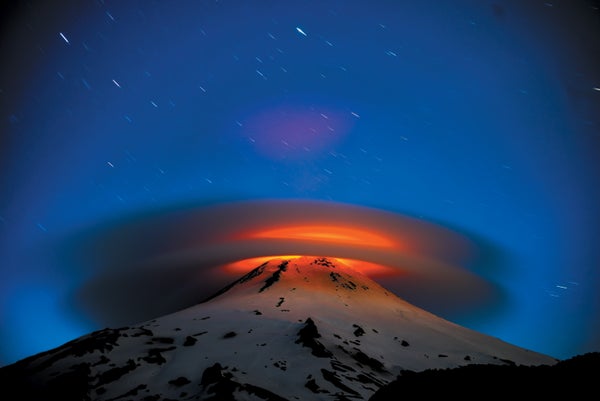
Villarrica is one of Chile’s most active volcanoes. Its Mapuche name, Rucapillán, means “house of the spirits,” and looking at it, it’s not hard to see why. But that isn’t some kind of otherworldly smoke ring wreathing Villarrica’s crater—it’s a cloud.
Lenticular clouds form when moist air flows up a mountain, volcano, or other geographic feature. These obstacles act like rocks in a stream, forcing air to travel around them in a stable, eddying pattern. As water-filled air rises into this current, it cools and condenses into visible clouds that drop after pushing over the summit, “sort of creating a wavelike motion,” says Corwin Wright, an atmospheric physicist at the University of Bath in England. The result is a seemingly stationary cloud that hovers over the landscape like a flying saucer or ominous-looking ring of smoke.
In addition to creating clouds that look like an alien invasion, these eddies play a vital role in global wind circulation. For example, they act as speed bumps that help to slow the Southern Hemisphere’s jet stream. “But you don’t normally see them day to day,” Wright says, “because obviously air is transparent.”
On supporting science journalism
If you're enjoying this article, consider supporting our award-winning journalism by subscribing. By purchasing a subscription you are helping to ensure the future of impactful stories about the discoveries and ideas shaping our world today.
Luckily for photographer Francisco Negroni, a lenticular cloud materialized over Villarrica when it was at its most dramatic for this award-winning shot. After the volcano entered a period of activity, Negroni camped at its snowy base for 10 days as he waited for the right moment. He then set up his camera and opened the lens for a full four minutes to capture enough light. That was enough time to track Earth’s rotation, which makes stars appear as streaks of light even as the volcano’s lenticular crown stays put. For Negroni, the shot was more than worth the effort. Photographing volcanoes “is my life,” he says.