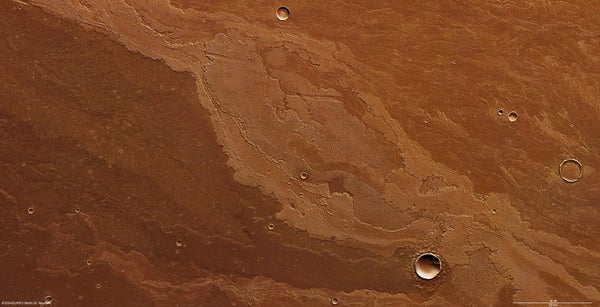
An image from the European Space Agency's Mars Express Orbiter , which has been patrolling the Red Planet for nearly six years, shows lava flows from a Martian volcano that may have been active in the last 100 million years.
ESA/DLR/FU Berlin (G. Neukum)
Join Our Community of Science Lovers!
On supporting science journalism
If you're enjoying this article, consider supporting our award-winning journalism by subscribing. By purchasing a subscription you are helping to ensure the future of impactful stories about the discoveries and ideas shaping our world today.
An image from the European Space Agency's Mars Express Orbiter, which has been patrolling the Red Planet for nearly six years, shows lava flows from a Martian volcano that may have been active in the last 100 million years. Mars's volcanoes are not thought to be active today, but some of them, such as Arsia Mons, appear to have been in recent geologic history.
This lava flow is on Daedalia Planum, a plain southeast of Arsia Mons, and reflects varying stages of volcanic deposition. The elevated, textured lava at the center of the image is more recent, whereas the raised flows on the lower left of the plain have been coated by sediments over time, smoothing their surface.
Two craters in the image show the transformative effects of lava flows on the Martian landscape: the large crater at bottom is relatively unscathed, while a similar-size crater on the right has been all but erased by volcanic floods.
If you enjoyed this article, I’d like to ask for your support. Scientific American has served as an advocate for science and industry for 180 years, and right now may be the most critical moment in that two-century history.
SciAm always educates and delights me, and inspires a sense of awe for our vast, beautiful universe. I hope it does that for you, too.
If you subscribe to Scientific American, you help ensure that our coverage is centered on meaningful research and discovery; that we have the resources to report on the decisions that threaten labs across the U.S.; and that we support both budding and working scientists at a time when the value of science itself too often goes unrecognized.