
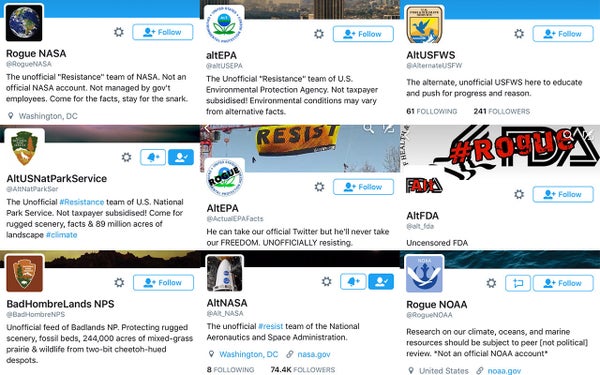
This week, after the Trump administration placed restrictions on several federal agencies regarding communication with the public, self-described "rogue" versions of government science institutions cropped up on Twitter, defiantly sharing their support of science.
The account AltUSNatParkService (@AltNatParkSer) launched Jan. 24, calling itself "The Unofficial #Resistance team of U.S. National Park Service" in a Twitter bio. Its tweets share facts related to climate changeand its impact on U.S. national parks — and on the planet — and call for more rigorous government support of science-based policies related to the environment.
Since then, numerous other accounts with similar intentions have sprouted on Twitter. NASA alone inspired several unaffiliated "rebel" namesakes, including @NASAGoneRogue ("NASA Employees taking a stand"), @RogueNASA ("The unofficial 'Resistance' team of NASA") and @NASARogueOne ("Rebel with a cause"). [The Reality of Climate Change: 10 Myths Busted]
On supporting science journalism
If you're enjoying this article, consider supporting our award-winning journalism by subscribing. By purchasing a subscription you are helping to ensure the future of impactful stories about the discoveries and ideas shaping our world today.
@AltNatParkSer appeared shortly after the Badlands National Park's official account posted several unauthorized, but highly popular, tweets affirming climate change. The tweets were later deleted, but they can still be seen in the many screengrabs captured by Twitter users.
After Trump order EPA not talk on social media, Badlands National Park went rogue & viral with these tweets... which got deleted 10min ago: pic.twitter.com/4RRiuego2i
— Scientists for EU (@Scientists4EU) January 24, 2017
Other "rebel" doppelgängers mirrored a number of federal science agencies: the U.S. Department of Agriculture, the Environmental Protection Agency, the National Oceanic and Atmospheric Administration and the National Weather Service, represented by (but not associated with) @altUSDA, @altUSEPA, @rogue_NOAA and @alternativeNWS, respectively.
Many identified themselves in their Twitter bios as "The Unofficial 'Resistance' Team" of whichever agency they represented.
The runaway popularity of @AltNatParkSer's tweets — the account quickly gathered over 14,000 followers — appeared to raise its founders' concerns regarding their continued involvement. On Jan. 26, the anonymous team tweeted that the members were handing the account over to activists and journalists who have science backgrounds but who are not federal employees, saying that they were making the decision "for the sake of our colleagues."
But first, they tweeted a message that was meant specifically for President Donald Trump, warning that if he and his administration continue to ignore the risks of climate change, the devastation it wreaks on the planet will stand as his legacy.
Climate change is real, Trump. You gotta deal with it now, or have the problems it creates be your legacy, for now & future generations.
— AltUSNatParkService (@AltNatParkSer) January 26, 2017
Copyright 2016 LiveScience.com, a Purch company. All rights reserved. This material may not be published, broadcast, rewritten or redistributed.