
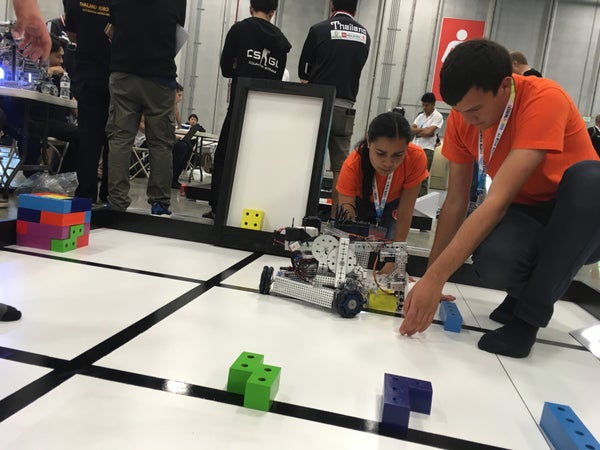
GUÁCIMA, ALAJUELA, Costa Rica—Hundreds of robots—some designed to play 3D Tetris or soccer, others to tackle some of Earth’s dire sustainability challenges—invaded this small Costa Rican town last weekend.
The machines were accompanied by their creators: 2,500 competitors, ages six to 25, from more than 60 countries, at the 14th World Robot Olympiad (WRO) held Nov. 10–12. This was the first time in the event’s 14-year history that it was held outside Asia. As host, Costa Rica had to decide the competition’s theme and chose “Sustainabots”—robots designed to contribute to sustainability, conservation and the United Nations’ Sustainable Development Goals. The conservation-minded Central American country, which has over 25 percent of its territory under protected areas, has launched official efforts to eventually become a carbon-neutral nation by drastically minimizing the use of fossil fuels for power generation and transportation.
Visitors strolling through the Olympiad’s exhibit booths found robotic approaches to reducing CO2 emissions from cars in streets of Mumbai; to quickly growing cattle feed without clearing land; and to venturing into the forest to count trees, map their locations, identify their species and determine dozens of other characteristics that might otherwise be carried out by a human botanist.
On supporting science journalism
If you're enjoying this article, consider supporting our award-winning journalism by subscribing. By purchasing a subscription you are helping to ensure the future of impactful stories about the discoveries and ideas shaping our world today.
“For the youngsters, this is not only a way for them to view science and technology as something fun and playful, but also for them to see how science, technology and engineering can solve problems that we have as a planet—challenges such as climate change, renewable energies and sustainable tourism,” said Carolina Vásquez-Soto, Costa Rica’s Minister of Science, Technology and Telecommunications.
The competition venue—the 9,000-square-meter Parque Viva exhibit hall—rang with languages from around the world. But the competitors seemed to understand each other through a shared love of building and programming robots. “Our main objective is to make children and teenagers fall in love with science and technology. Robotics is one of many tools by which you can achieve that,” said Alejandra Sánchez, a mechanical and electrical engineer who teaches robotics at the University of Costa Rica and was a key organizer of the event.
The contest was not just about sustainability; one of its highlights was a robotic soccer tournament mimicking a FIFA World Cup. In front of bleachers covered in flags and fans from their resepective homelands, teams from some 60 countries—each represented by two soccer-playing robots—faced each other. The winners of each match advanced to the next round until the final game was won by Taiwan, playing under the name “Chinese Taipei.” At another popular event, college students unleashed their robots to score as many points as possible in “Tetrastack,” a real-world, three-dimensional version of the video game Tetris.
Meanwhile, elementary and high school students minded robots (built using Lego Mindstorm pieces) that took on challenges related to sustainable tourism, carbon neutrality, and renewable and clean energy. Russia was the big winner, taking home the gold in all three categories.
According to Sánchez, the $1.2-million Olympiad received support from the Costa Rican government and private local sponsors. It was organized by Aprender Haciendo (Learn Through Doing)—the representative of LEGO education for Costa Rica and Panama—in collaboration with the National Center for High Technology and the country’s Ministry of Science, Technology and Telecommunications. Next year the World Robotic Olympiad will be hosted by Thailand.