
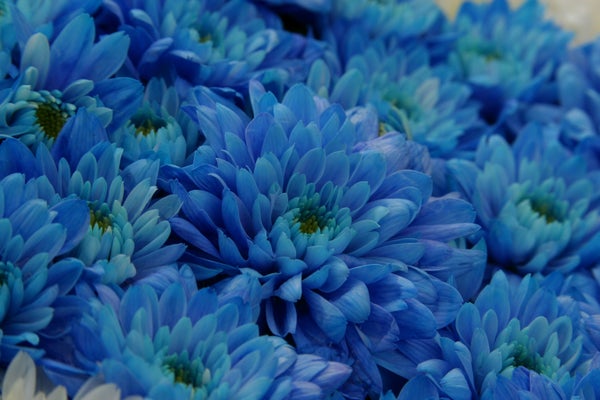
Roses are red, but science could someday turn them blue. That’s one of the possible future applications of a technique researchers have used to genetically engineer blue chrysanthemums for the first time.
Chyrsanthemums come in an array of colours, including pink, yellow and red. But all it took to engineer the truly blue hue—and not a violet or bluish colour—was tinkering with two genes, scientists report in a study published on July 26 in Science Advances. The team says that the approach could be applied to other commercially important flowers, including carnations and lilies.
“Consumers love novelty,” says Nick Albert, a plant biologist at the New Zealand Institute for Plant & Food Research in Palmerston North, New Zealand. And “people actively seek out plants with blue flowers to fill their gardens”.
On supporting science journalism
If you're enjoying this article, consider supporting our award-winning journalism by subscribing. By purchasing a subscription you are helping to ensure the future of impactful stories about the discoveries and ideas shaping our world today.
Plenty of flowers are bluish, but it’s rare to find true blue in nature, says Naonobu Noda, a plant researcher at the National Agriculture and Food Research Organization near Tsukuba, Japan, and lead study author. Scientists, including Noda, have tried to artificially produce blue blooms for years: efforts that have often produced violet or bluish hues in flowers such as roses and carnations. Part of the problem is that naturally blue blossoming plants aren’t closely related enough to commercially important flowers for traditional methods—including selective breeding—to work.
Most truly blue blossoms overexpress genes that trigger the production of pigments called delphinidin-based anthocyanins. The trick to getting blue flowers in species that aren’t naturally that colour is inserting the right combination of genes into their genomes. Noda came close in a 2013 study when he and his colleagues found that adding a gene from a naturally blue Canterbury bells flower (Campanula medium) into the DNA of chrysanthemums (Chrysanthemum morifolium) produced a violet-hued bloom.
Getting the blues
Noda says he and his team expected that they would need to manipulate many more genes to get the blue chrysanthemum they produced in their latest study. But to their surprise, adding only one more borrowed gene from the naturally blue butterfly pea plant (Clitoria ternatea) was enough.
Anthocyanins can turn petals red, violet or blue, depending on the pigment’s structure. Noda and his colleagues found that genes from the Canterbury bells and butterfly pea altered the molecular structure of the anthocyanin in the chrysanthemum. When the modified pigments interacted with compounds called flavone glucosides, the resulting chrysanthemum flowers were blue. The team tested the wavelengths given off by their blossoms in several ways to ensure that the flowers were truly blue.
The quest for blue blooms wouldn't only be applicable to the commercial flower market. Studying how these pigments work could also lead to the sustainable manufacture of artificial pigments, says Silvia Vignolini, a physicist at the University of Cambridge, UK, who has studied the molecular structure of the intensely blue marble berry.
Regardless, producing truly blue flowers “is a great achievement and demonstrates that the underlying chemistry required to achieve 'blue' is complex and remains to be fully understood”, says Albert.
This article is reproduced with permission and was first published on July 26, 2017.