
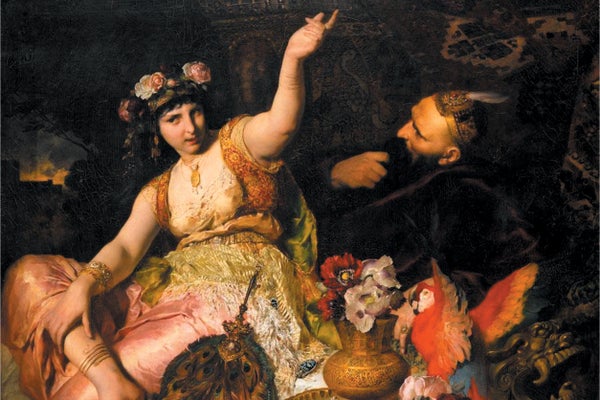
King Shahryar, betrayed by his wife, decides to marry a new woman each night and have her executed by morning to ensure he is never deceived again. After Scheherazade volunteers to marry the king, she outsmarts him. She begins a gripping story every evening but stops telling it at dawn, leaving her husband eager for more. Night after night she keeps him hooked with new tales, and over the course of 1,001 nights he falls in love with her and abandons his cruel ways.
This story is the frame of One Thousand and One Nights, a medieval collection of Middle Eastern folktales—including the stories of Aladdin, Ali Baba and Sinbad—that highlight the power of storytelling. But can storytelling skills indeed save a person’s life in the real world?
The findings of recent research by my colleagues and me don’t go that far yet, but they do show that strong storytelling skills can dramatically improve someone’s well-being. This result hints that, yes, skillful storytellers may actually live longer. How, exactly? You’ll have to wait until the end of this story to find out. No peeking!
On supporting science journalism
If you're enjoying this article, consider supporting our award-winning journalism by subscribing. By purchasing a subscription you are helping to ensure the future of impactful stories about the discoveries and ideas shaping our world today.
Our journey starts with extensive research on narrative identity showing that people make sense of who they are by shaping their life experiences into a story—one that gives their life meaning. The idea is that by connecting our experiences, we can recognize the guiding force that has shaped our journey (for instance, the belief that we like helping people) and, in turn, uncover our sense of purpose and meaning in life.
In our research, my colleagues and I shift the focus from stories, particularly life stories, to storytelling. We suggest that compared with others, skillful storytellers have a stronger sense of meaning in life and approach their experiences with what we call a “why mindset”—that is, they focus on their reasons for doing what they do rather than just on how they do it.
Across all studies and measures, we consistently found that storytelling ability is linked to both a sense of meaning in life and a mindset focused on the whys.
Our hypothesis about storytellers is rooted in the nature of stories. The typical narrative focuses on a hero who strives to achieve a goal, such as landing a job or winning someone’s heart, while facing various obstacles and challenges along the way. Therefore, to excel at storytelling, individuals must develop two key skills. First, they need to connect the dots—the events of the story—in a meaningful way to create a coherent narrative. Second, they must learn to see the world through the eyes of their characters, understanding the why of what drives people. In applying these two skills to their own lives, talented storytellers use the first to identify and pursue what gives their life meaning and the second to foster a mindset that prioritizes the why behind their actions over the how.
To illustrate this point, let’s imagine two people: Rachel and Monica. Both had the same career path, and both worked in multiple, vastly different industries, including sports, medicine and banking. Throughout their careers they often acted on impulse. Rachel is a skillful storyteller, however, and Monica isn’t. This difference comes across vividly when they reflect on their careers. Monica is more likely to feel lost and to lack clarity about her sense of meaning and purpose in life because she doesn’t possess a why mindset, having always focused on how to get things done rather than the bigger picture. Rachel, in contrast, is inclined to reflect more deeply on her life and see connections, such as the fact that in all her managerial jobs she used her position to bolster the presence of women in decision-making roles. This observation gives her a sense of purpose and a deeper understanding of what drives her—that is, her why. But this story is just hypothetical. Does it pan out in real life?
To examine how a skill for narrative serves storytellers, we conducted five studies with about 800 participants. To reliably measure storytelling ability, we took a multifaceted approach. First, we developed and tested a questionnaire in which we asked people how much they agreed with statements such as “my stories usually excite my listeners.” Second, we interviewed close friends of the participants about their storytelling skills. Third, we invited trios of strangers to our laboratory and asked them to share stories with one another. In our lab experiment, each participant told two distinct stories: one about a personal trait and one that incorporated three random words we provided, a task designed to isolate the core mechanics of storytelling.
This approach is a significant departure from previous studies of life stories—here we are really homing in on the ability to craft a compelling narrative from minimal material. As part of the experiment, each participant rated the storytelling ability of the others in their trio, and afterward storytelling experts—people who had just completed a course on the subject—reviewed video recordings of the sessions and provided independent ratings. Thus, we had four measures of storytelling skill: (1) people’s self-reports of their own ability, (2) opinions of close friends, (3) ratings from other members of the trio in our lab experiment and (4) evaluations from storytelling experts. In addition to these assessments, we asked participants questions to get a sense of how meaningful they found life and whether they approached decisions with a why mindset rather than a how mindset.
Across all studies and measures, we consistently found that storytelling ability is linked to both a sense of meaning in life and a mindset focused on the whys. When we tested whether personality traits might be driving our findings, we found they weren’t. That said, personality did add interesting nuance. People who are naturally open to new experiences tend to be better storytellers, for example. That makes sense: such people are more likely to be part of unique and interesting events that lend themselves to great stories, and these encounters give these individuals more opportunities to refine their storytelling skills as they share their experiences with others.
We also found that storytelling skills related to meaning in life for introverts more than they did for extroverts. In general, extroverts have a stronger sense of meaning in life, but storytelling may help introverts compensate for that difference. Both storytelling and extroversion are related to expressiveness. Extroversion is all about the urge to express yourself in social settings, whereas storytelling is about having a knack for doing so through stories. It turns out that either one of these tendencies can be enough to spark a sense of meaning and purpose.
This work offers several lessons. First, because people with a why mindset, by definition, excel at seeing the big picture, our findings suggest that the abilities to tell stories well and to see the big picture are closely related. Although seeing the big picture is useful in its own right, it may also be a crucial advantage that humans have over artificial intelligence, which excels at executing micro tasks. Thus, when we are facing an uncertain future, our ability to tell stories is something we should treasure and cultivate.
My team’s findings also suggest that storytelling workshops—which have grown popular in recent years—influence people’s lives in ways that go beyond improving communication and persuasion. They may strengthen the driving force of our existence and sharpen our sense of direction in life.
The benefits of cultivating greater purpose are many, and some of them are unexpected. Past research has found that a strong sense of meaning in life is associated with many health benefits, including a longer lifespan. Combined with our findings, this outcome suggests storytelling may also contribute to better health and decreased mortality. Plus, storytelling helps people connect, which can naturally expand their social circles. Because strong social relationships are known to boost health and even influence longevity, it makes sense that storytelling could indirectly support physical health by fostering deeper and broader social ties.
Perhaps One Thousand and One Nights was correct all along: storytelling may help save your life.
Are you a scientist who specializes in neuroscience, cognitive science or psychology? And have you read a recent peer-reviewed paper that you would like to write about for Mind Matters? Please send suggestions to Scientific American’s Mind Matters editor Daisy Yuhas at dyuhas@sciam.com.