
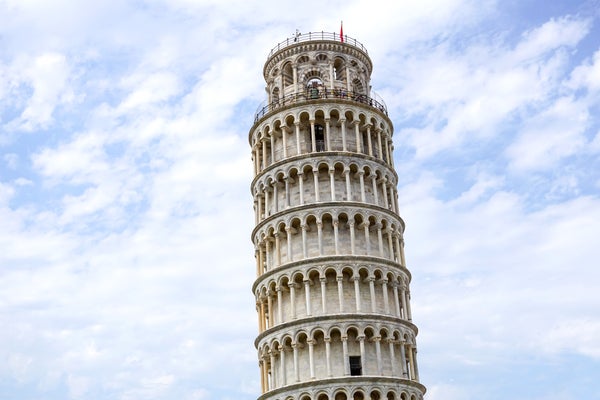
Once every year, engineers measure the Leaning Tower of Pisa’s precarious tilt. Last week they announced that the tower had been self-correcting for more than a decade and had finally stopped. The surprise gain straightened the landmark by four centimeters. Although that may seem small, it is a welcome gift after centuries of worry that the building would simply topple.
The news came to John Burland, an emeritus professor at Imperial College in London, by way of a 4 A.M. phone call. Back in 1989 the soil-mechanics expert had been approached to lead a 13-member commission to save the structure from collapsing. The top-heavy bell tower, built in 1173 on spongy ground, seemed to defy the laws of physics. “No matter how many calculations we made, the tower should not have been standing at all,” Burland told Scientific American. “The height and weight coupled with the porous soil meant it should have fallen centuries ago.” Although today he still cannot explain for sure why it still stands, he is certain it would not have lasted much longer if the commission had not intervened.
The resurrection work began in 1992. At that time the north side of the tower’s base had sunk, leading to a 5.5-degree slope toward the north of the 187-foot, 14,700-metric-ton structure. When the project ended in 2001 the slope has been reduced to just under five degrees, leaving the tower about 13 feet from the perpendicular.
On supporting science journalism
If you're enjoying this article, consider supporting our award-winning journalism by subscribing. By purchasing a subscription you are helping to ensure the future of impactful stories about the discoveries and ideas shaping our world today.
Burland’s team painstakingly extracted about 20 liters of soil at a time from under the south side of the base and steadily installed a system of tunnels and wells to drain the water that was keeping the soil wet, causing the base to sink. The reparations raised the base on the north side by four meters and lifted the entire tower along with it. While digging, Burland says they found the remnants of a concrete foundation that had been built in 1828; they attached the tower to it with massive chains, creating even stronger footing.
They also attached metal rings around the fifth floor of the tower, which had cracked during repair, and hitched heavy weights with steel cables on the opposite side to help settle the building into the newly drained foundation. When all was done, the tower had straightened 40 cm, bringing it to the same inclination it had in 1810. That year marked the beginning of a period of tremendous movement—and failed interventions. It gradually leaned more each year until 1989, when it surpassed the 5.5-degree incline. That’s when the city closed the edifice to tourists and cleared the land below, assuming it would fall.
Burland calls the additional 4 cm gained since the intervention was completed in 2001 an added bonus. But he is not surprised. “It is about what I expected," he says, although he had made no projections at the time. The tower continued to settle, but that stopped several years ago. The engineers waited until the latest annual checkup to declare that they think the auto-correct has stopped. Given that, Burland says, “I don’t expect it to ever be completely straight.” He hopes the building will now be stable and not start to lean further again as the soil underneath naturally erodes and shifts.
In fact, the tower could never be straight, even if the incline were completely corrected. Shortly after construction began in 1173, the tower had begun to lean noticeably. Engineer Bonnano Pisano, who designed the tower, sought to correct it by simply curving it upward as the builders continued. They made pillars on the third and eighth floors taller on the north side. “It is like a banana,” Burland says. “The thing was never straight.”
Engineers expect the tower to last at least 200 years before it needs another intervention, based on projected soil condition and stone quality. The underground tunnels and wells have also made the ancient building highly resistant to seismic activity, which is especially important in Italy, where earthquakes have destroyed historic structures recently.
“I can’t see any reason why it shouldn’t be standing in 200 years,” Burland says. “I could not have said that when I first started the project, but such optimistic statements are now easy to make.”