
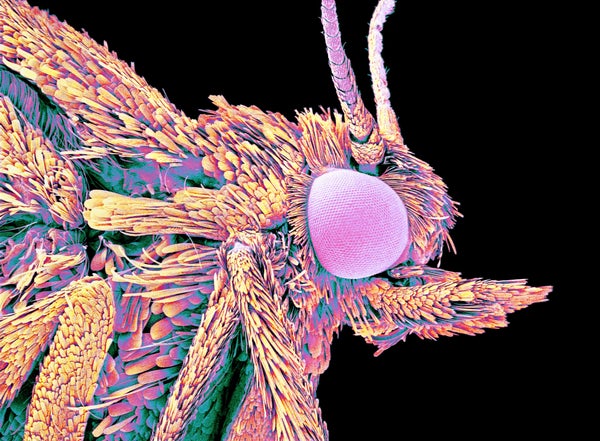
It is a summer night, and the moths are all aflutter. Despite being drenched in moonlight, their eyes do not reflect it—and soon the same principle could help you see your cell-phone screen in bright sunlight.
Developing low-reflectivity surfaces for electronic displays has been an area of intensive research. So-called transflective liquid-crystal displays reduce glare by accounting for both backlighting and ambient illumination. Another approach, called adaptive brightening control, uses sensors to boost the screen's light. But both technologies guzzle batteries, and neither is completely effective. The anatomy of the moth eye presents a far more elegant solution, according to Shin-Tson Wu of the University of Central Florida, who described a technique for making an insect-inspired display coating recently in Optica.
When light moves from one medium to another, it bends and changes speed as the result of differences in a material property called refractive index. If the difference is sharp—as when light moving through air suddenly hits a pane of glass—much of the light is reflected. But a moth's eye is coated with tiny, uniform bumps that gradually bend (or refract) incoming light. The light waves interfere with one another and cancel one another out, rendering the eyes dark.
On supporting science journalism
If you're enjoying this article, consider supporting our award-winning journalism by subscribing. By purchasing a subscription you are helping to ensure the future of impactful stories about the discoveries and ideas shaping our world today.
Wu and his colleagues at National Taiwan University created a silicon dioxide mold that resembles a moth's eye surface and used it to produce a hard, dimpled coating on a flexible sheet. Although these dimples are concave rather than convex such as those on the moth's eye, they prevent glare in the same way. In tests, the material resulted in less than 1 percent reflectance.
“The main barrier to the wide-scale adoption of this approach is its cost,” says Stuart Boden, who researches semiconductor device fabrication at the University of Southampton in England and who was not involved in the new work. Wu is hoping to find a commercial partner to scale up the technology.