
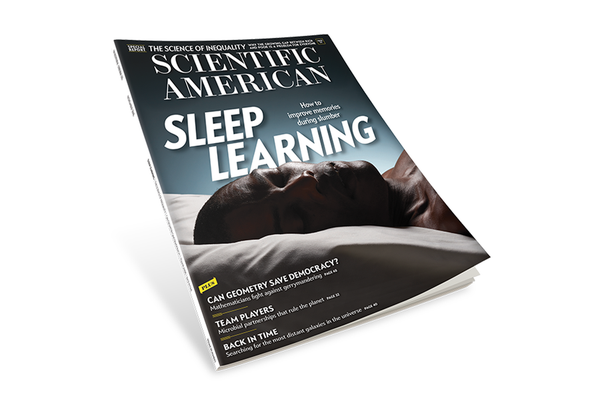
In our cover story, “Sleep Learning Gets Real,” by Ken. A. Paller and Delphine Oudiette, we focus on a topic that has long held healthy measures of both fascination and speculation for many of us: maximizing the one third of our lifetime spent in slumber. Evoking the cultural allure of the prospect, the article opens with a reference to Aldous Huxley's 1932 classic, Brave New World, where students are, in effect, programmed overnight by their totalitarian authorities.
The nonfiction truth is, as usual, both less extreme and, in a number of ways, more illuminating in what it reveals about the brain. As you'll learn, we won't be imprinting brand-new ideas into anybody's snoozing brain anytime in the near future. Through controlling the process of memory reactivation, however, researchers are investigating how we can improve learning during our nightly periods of downtime. The work could someday help us promote problem-solving while asleep, stop nightmares or perhaps guide the outcome of our dreams.
Dystopian fiction such as Brave New World has a useful role in conjuring possible futures that could arise from today's science and technology trends. But learning while sleeping was only one such idea explored by Huxley. Another was the conception of a society where privileges followed a ranking system based on genes. When I first read the work, in high school, I was struck by the distance between the top and bottom tiers.
On supporting science journalism
If you're enjoying this article, consider supporting our award-winning journalism by subscribing. By purchasing a subscription you are helping to ensure the future of impactful stories about the discoveries and ideas shaping our world today.
But that was fantasy. In the real world, the divide between the wealthy at the top and the poor at the bottom is even worse. The gaps are already severe and growing—with impacts that affect almost every aspect of human well-being, from our personal health to that of the biosphere. In this issue's special report on “The Science of Inequality,” led by senior editor Madhusree Mukerjee, we take a deep dive into the challenges—and some ways to alleviate them.
For instance, economist Joseph E. Stiglitz looks at why inequality is higher in the U.S. than in almost all other advanced countries (“A Rigged Economy”). Neuroscientist Robert M. Sapolsky looks at the effects of inequality on physical and mental health (“The Health-Wealth Gap”). The most vulnerable members of society are often hurt, rather than helped, by digital systems, explains political scientist Virginia Eubanks (“Automating Bias”). Rounding out the section, economist James K. Boyce describes how inequality damages the environment and some of the ways communities are combating such harm (“The Environmental Cost of Inequality”). Considering the importance of the challenges facing us now and in the future if we don't tackle them, we might ask: When will we learn? Let's hope it's soon.