
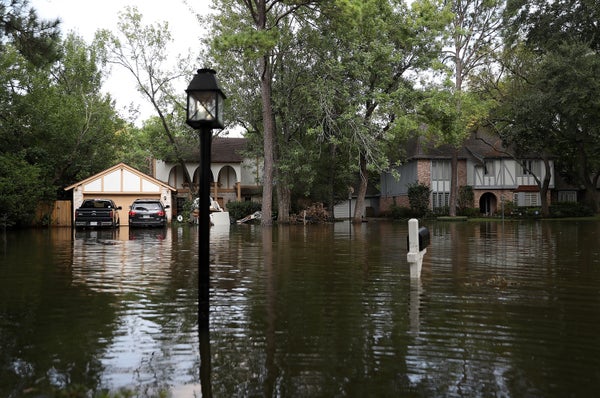
Government buyouts of flood-damaged homes are becoming more common in cities like Houston to eliminate risk for people in floodplains while reducing taxpayer costs to repair infrastructure like power and sewer lines.
But researchers from the Nature Conservancy and Texas A&M University say buyout programs are often shortsighted and place too much emphasis on obtaining at-risk properties across large geographic areas, rather than targeting smaller parcels where reclaimed properties are close to natural features like streams that provide environmental services.
While endorsing the concept of buyouts as a cost-effective form of flood mitigation, those groups said in a report yesterday that such programs “are almost always initiated in a reactionary, ad hoc manner after a flood event has occurred.” That results in an “uncoordinated, checkerboard pattern of open spaces that does little to protect environmental assets or remove groups of structures from areas vulnerable to flooding over the long term.”
On supporting science journalism
If you're enjoying this article, consider supporting our award-winning journalism by subscribing. By purchasing a subscription you are helping to ensure the future of impactful stories about the discoveries and ideas shaping our world today.
As an alternative, the researchers say municipalities—both large and small—should adopt a “proactive framework for identifying candidate parcels for acquisition in advance of storm events.” And instead of basing buyout decisions on simple benefit-cost ratio analyses, officials should consider an area’s “proximity to important ecological features such as wetlands and protected areas, as well as ongoing open space restoration plans and projects.”
Acquiring flooded properties and removing structures “are just the first steps,” the authors wrote. “Working with affected communities to reclaim the environmental and social benefits of these spaces gives us an opportunity to restore and enhance neighborhood living for local residents.”
The research findings are based on reviews of more than 74,000 properties in the Houston area that were damaged or destroyed by Hurricane Harvey in 2017. Researchers say Houston offers a unique window into questions about how to reduce flood risk while enhancing community resilience to future disasters.
Of the studied properties affected by Hurricane Harvey, about 3,500 have experienced repetitive flood loss claims, according to the researchers, totaling about $634 million between 1978 and 2017.
Critics of government programs that rebuild flooded homes say those high costs demonstrate the need for new approaches that merge disaster assistance and public safety goals with environmental ones.
“Essentially, we’re saying these [buyout] programs need to be more proactive and less reactive,” said Lily Verdone, director of freshwater and marine programs for the Nature Conservancy of Texas and one of five co-authors of the report.
According to officials in Harris County, which encompasses much of Houston, roughly 9,000 properties were eligible for buyout when Hurricane Harvey struck in August 2017. Of those, 3,000 have been purchased and reclaimed as open space for stormwater drainage and absorption.
The remaining 6,000 properties—3,500 with homes and 2,500 vacant lots—are concentrated in roughly 70 areas and could be purchased as funds become available, said James Wade, manager of property acquisition for the Harris County Flood Control District.
While endorsing the report’s core recommendations, James defended the agency’s record of prioritizing buyouts in high-risk areas, pointing to an agency map showing the roughly 70 “buyout areas of interest,” including along some of the city’s most flood-prone bayous and drainages.
“I think we’re already taking that clustered approach, and maybe it was implied that we could have been doing a better job of that,” Wade said.
“Each buyout area is kind of different,” Wade added. “In some of these areas, there’s a lot of homes, so you have to do a lot of maintenance—mowing lawns and trimming trees. In other areas, where it’s more rural, [a property] can just go back to nature for low-intensity use.”
The report’s authors say the research is not meant to be criticism of Harris County’s flood buyout program. Rather, the county provides an ideal testing ground for the researchers’ core hypotheses, given its large size, the magnitude of flooding from Hurricane Harvey, and the number of homes and properties being considered for public buyout.
“The people who are in charge of the buyout program in Harris County and in the other smaller municipalities, they work hard, and they have a large task in front of them,” said Wesley Highfield, a co-author and Texas A&M associate professor.
Even so, he said, the “checkerboard is still there,” and policymakers need to know the limitations and downsides associated with such an approach.
“I think when we visualize this in our heads, we’re seeing things more at the neighborhood scale, where we’re targeting five, 10, maybe 20 structures,” Highfield said. “The approach is economical, and it offers additional environmental benefits using a clustering perspective.”
Authors said the findings can also be applied to other flood-prone regions, in both coastal zones and inland areas that are subject to riverine flooding.
Reporter Mike Lee contributed.
Reprinted from Climatewire with permission from E&E News. E&E provides daily coverage of essential energy and environmental news at www.eenews.net.