Lightning Strikes Are a Big Problem for Wind Turbines

See the high-voltage lab in Denmark exploring how to safeguard turbines from electrical surges

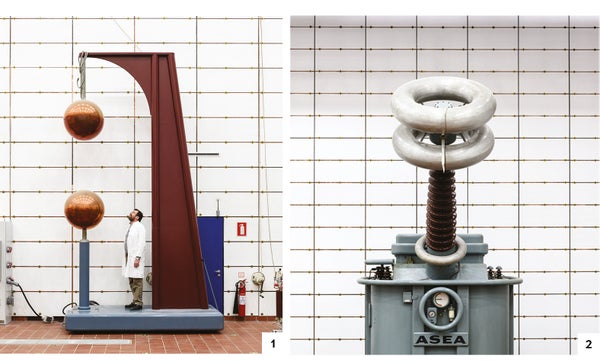
Holbøll with a highvoltage sphere gap (1). A 400,000-volt single-phase transformer (2).

ALASTAIR PHILIP WIPER

Join Our Community of Science Lovers!


On supporting science journalism

If you're enjoying this article, consider supporting our award-winning journalism by subscribing. By purchasing a subscription you are helping to ensure the future of impactful stories about the discoveries and ideas shaping our world today.


Wind turbines are lightning magnets—and strikes on these tall, spinning structures can cause significant damage. Blades explode; generators and control system electronics fry. To figure out how to safely disperse lightning, turbine manufacturers have turned to the Technical University of Denmark's High Voltage Lab. Using giant versions of standard electrical devices such as sphere gaps, transformers and capacitors, the facility can generate huge arcs of electricity—up to 800,000 volts AC. The equipment helps companies test how new turbine parts or mechanisms will respond to electrical surges out in the field.

“Many high-voltage labs, they look like something from the 1960s,” says Joachim Holbøll, a professor and deputy head of the university's Center for Electric Power and Energy. “But we are doing necessary stuff in there with the newest equipment. Parts of this will always look a little old-fashioned, but that is simply because it works.”

The lab is also tackling a new problem: wind turbines are getting so tall that they frequently generate “up lightning.” This type originates from the turbine's own electric field and leaps from the tip of a blade to meet a downward bolt. The direction of the bolt does not change the form of protections that the turbines need, Holbøll says. But understanding these dynamics is critical to modeling the frequency of lightning strikes at wind farms, and the High Voltage Lab is working to verify theoretical and computational descriptions of this phenomenon. In 2015 wind power provided 42 percent of the electricity Denmark consumed.

About Karl J. P. Smith

Karl J.P. Smith is a AAAS Mass Media Fellow and current PhD candidate in biophysics, computation, and structural biology at the University of Rochester. He is the typewriting storyteller behind the 10 cent story project and is the co-creator of the Bench Warmer's Podcast.

More by Karl J. P. Smith
Scientific American Magazine Vol 315 Issue 6This article was published with the title “Surge Protector” in Scientific American Magazine Vol. 315 No. 6 (), p. 21
doi:10.1038/scientificamerican1216-21

It’s Time to Stand Up for Science

If you enjoyed this article, I’d like to ask for your support. Scientific American has served as an advocate for science and industry for 180 years, and right now may be the most critical moment in that two-century history.

I’ve been a Scientific American subscriber since I was 12 years old, and it helped shape the way I look at the world. SciAm always educates and delights me, and inspires a sense of awe for our vast, beautiful universe. I hope it does that for you, too.

If you subscribe to Scientific American, you help ensure that our coverage is centered on meaningful research and discovery; that we have the resources to report on the decisions that threaten labs across the U.S.; and that we support both budding and working scientists at a time when the value of science itself too often goes unrecognized.

In return, you get essential news, captivating podcasts, brilliant infographics, can't-miss newsletters, must-watch videos, challenging games, and the science world's best writing and reporting. You can even gift someone a subscription.

There has never been a more important time for us to stand up and show why science matters. I hope you’ll support us in that mission.

Thank you,

David M. Ewalt, Editor in Chief, Scientific American

Subscribe