
Key concepts
Physics
Adhesion
Cohesion
Surface tension
Gravity
Introduction
How do trees suck water all the way up to their leaves? How do paper towels soak up a spill? Are these things related? Try this project to learn about capillary action, and repeat a classic demonstration from over 100 years ago!
Background
Have you ever looked closely at water in a drinking glass? You might notice the surface of the water is not completely flat, rather it forms a small lip, called a meniscus, that curls up around the edge of the glass. This occurs because of two forces: adhesion (the attraction between the water molecules and the glass) and cohesion (the attraction of water molecules with one another). Cohesion among water molecules gives rise to surface tension, or the way water’s surface acts like a stretchy “skin.” Surface tension helps prevent raindrops from breaking apart and allows insects such as water striders to walk on water without sinking. It also contributes to the water rising along the edge of the glass: As some water molecules are pulled up because of their attraction to the glass, they pull others on the surface along with them.
On supporting science journalism
If you're enjoying this article, consider supporting our award-winning journalism by subscribing. By purchasing a subscription you are helping to ensure the future of impactful stories about the discoveries and ideas shaping our world today.
This phenomenon, called capillary action, allows water to be sucked up into small gaps, seemingly defying gravity. This might not seem like a big deal for a meniscus that’s only a couple millimeters high in a glass of water. But what about a paper towel sucking water up a few inches or a tree pulling it up tens or even hundreds of feet? How can they possibly get the water up so high? In this activity you will investigate how the size of the gap affects the height to which the water will rise.
Materials
Two small picture frames with glass covers
Two paper clips
Rubber band
Tray or plate
Water
Food coloring
Dish towel
Preparation
Gather your materials on a work surface that can tolerate spills of food-colored water.
Fill a tray or plate with a shallow layer of water and mix in a few drops of food coloring.
Remove the glass plates from the picture frames.
Procedure
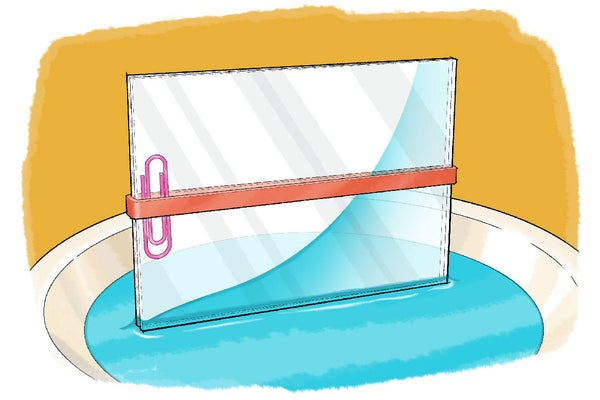
Use the rubber band to hold the two glass plates together, with the two paper clips in between opposite edges as spacers. Do you think you can get water to defy gravity?
Dip one edge of the glass plates (a side without a paper clip) into the water. Hold the plates still and wait a few seconds. What happens?
Separate the glass plates and wipe them dry with a towel.
Use the rubber band to hold the plates together again but this time only use one paper clip on one side (so at the opposite edge the glass plates should be touching each other).
Dip one edge of the glass plates (one of the sides adjacent to the side with the paper clip, not opposite it) into the water again. Hold the plates still and wait for a few seconds. What happens this time?
Extra: Try modifying the parameters of the tests, for example by using larger or smaller plates of glass; a thicker or thinner object as a spacer instead of a paper clip; a different liquid; etcetera. How do the results change?
Observations and results
When you put two paper clips between the glass plates as spacers, the width of the gap between them was the same everywhere. When you dipped the edge of the glass plates into the water, it was sucked up into the gap by capillary action (and the food coloring made this easier to see). Because the gap was the same width everywhere the water should have risen to about the same height along the length of the plates.
When you remove one of the paper clips something interesting happens: The gap is now wider on one end and gradually gets narrower until it disappears and the glass plates touch. This time when you dip the plates in the water, it goes up higher as the gap gets narrower. The resulting shape is called a hyperbola. This demonstrates how capillary action can lift water up higher in narrower spaces. As the gap gets wider the weight of the water increases faster than the force available to pull it up, thus the water cannot rise as high. So if you want to suck water up very high (such as all the way into a tree), you need a very narrow gap!
Cleanup
Use a towel to clean any spilled water and wipe the glass plates dry.
More to explore
Soap Bubbles and the Forces Which Mold Them, by C. V. Boys, from Project Gutenberg
Capillary Action, from Hyperphysics
Walking Water, from Scientific American
Staining Science: Capillary Action of Dyed Water in Plants, from Scientific American
Science Activities for All Ages!, from Science Buddies
This activity brought to you in partnership with Science Buddies
