
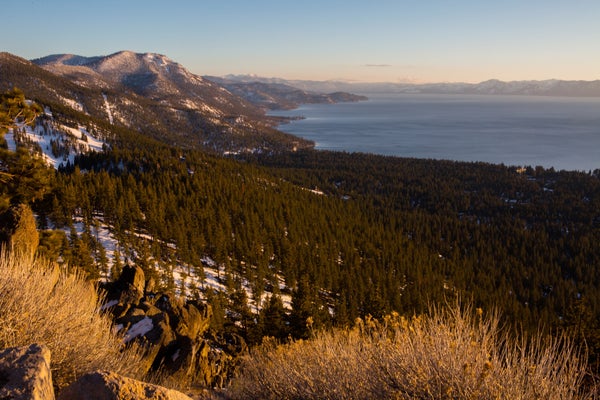
Little snow remains in California, officials say—another sign the state could face a dry and dangerous summer.
The California Department of Water Resources announced Friday that the amount of statewide snowpack had fallen to just 38 percent of the average for that date.
As if to underscore the point, California officials stood on browning grass after a snow survey Friday in the South Lake Tahoe area. In that location, the only patch of snow available to measure was 2.5 inches deep, while the snowpack in a normal season should be about 5 feet deep, said Sean de Guzman, a California Department of Water Resources forecasting manager.
On supporting science journalism
If you're enjoying this article, consider supporting our award-winning journalism by subscribing. By purchasing a subscription you are helping to ensure the future of impactful stories about the discoveries and ideas shaping our world today.
January through March were the driest months in more than 100 years of recorded history for the Sierra Nevada mountain range, he said.
The results highlighted the impact of climate change, said California Natural Resources Secretary Wade Crowfoot.
“Climate change is here and it’s changing our state and changing our region,” said Crowfoot, clad in jeans and a windbreaker. Warmer “winter temperatures mean less snowpack” and “increasing temperatures in the spring, in the summer, in the fall, mean more of the snow and the rain that does fall in our winter is absorbed into dry, increasingly thirsty soil and evaporates into warming temperatures.”
The nation’s most populous state isn’t alone in dealing with drought, Crowfoot noted. Water woes plague the West.
“Consider the Colorado River Basin, a river system that provides water to seven states and two countries, currently experiencing a drought of over 20 years, and right now experiencing some of its most alarming water conditions in recorded history,” Crowfoot said.
In California, the April 1 snow survey is the last one in the state’s wet season and signals what the coming months will look like in terms of water supply. Nearly all of California is in a state of severe or extreme drought, according to the U.S. Drought Monitor.
It’s raised concerns about how California will prevent more catastrophic wildfires this summer and fall. A lack of melting snowpack could spell doom for many grasses, trees and other plants. As those die, it raises the risk that fires could spread quickly (Climatewire, March 31).
Snowpack at the South Lake Tahoe site has plummeted since the beginning of the year. On Dec. 30, following a few robust snowstorms, the snowpack stood at 202 percent of normal for that date, de Guzman said.
But unseasonably warm weather and a lack of more precipitation in January through March cut the snowpack. April 1 should be when the snowpack is at its highest, but statewide snowpack likely peaked in early March this year, he said.
The focus in California now shifts to getting through summer and fall on existing water supplies. Democratic Gov. Gavin Newsom so far has resisted imposing mandatory water cutbacks on residents. He’s asked Californians to voluntarily reduce their water use by 15 percent.
Last week, Newsom directed the State Water Resources Control Board to consider a ban on the watering of decorative grass at businesses and institutions.
Both state and federal government water supply programs are limiting water deliveries in California.
The State Water Project provides a portion of water supplies for 27 million residents and about 750,000 acres of agriculture in the state’s Central Valley. It has limited deliveries to 5 percent of requests, plus any health and safety needs.
The Bureau of Reclamation also is cutting deliveries, citing “critically dry” conditions. It said effective April 1, water supplies for all Central Valley municipal and industrial water service contractors will be reduced to public health and safety needs only.
Reprinted from E&E News with permission from POLITICO, LLC. Copyright 2022. E&E News provides essential news for energy and environment professionals.