
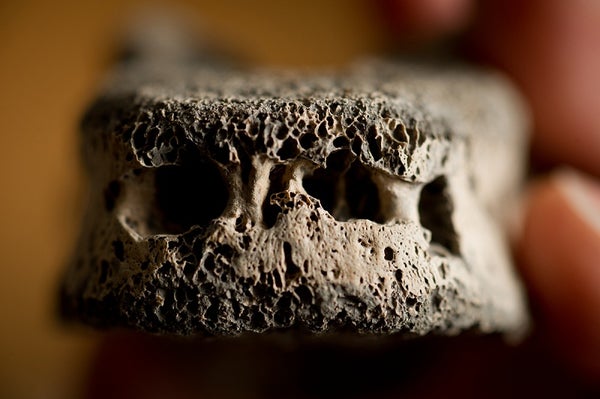
During an archaeological dig in Butrint, Albania, Michigan State University (M.S.U.) anthropologist Todd Fenton was busy classifying human bones by age and sex when he discovered several skeletons that were dramatically different from the others. Where there should have been solid bone within the spinal column, several specimens were ravaged with holes and lesions.
"The vertebral surface is usually complete, even in a 1,000-year-old fossil," Fenton says. But in these particular specimens, pictured in the image above, "there are destructive holes in the bone, and those are from disease. The columns of bone that you can see are leftover parts of the bone that were getting eaten around when the person was alive."
At first Fenton thought that these inhabitants, who had lived in medieval times between the 10th and the 13th centuries, had suffered from tuberculosis, which can attack the skeleton. So David Foran, a forensic scientist who works with Fenton at M.S.U., drilled into the bones to try to extract the DNA of the ancient bone-munching bacteria. After a year of trying, however, the search turned up nothing.
On supporting science journalism
If you're enjoying this article, consider supporting our award-winning journalism by subscribing. By purchasing a subscription you are helping to ensure the future of impactful stories about the discoveries and ideas shaping our world today.
Then the team got another idea. "A lot of people have found tuberculosis in ancient remains, but no one's ever confirmed brucellosis before," Foran says. Brucellosis is another bacterial infection, which spreads via raw milk and tainted meat products. Though lesser known in the archaeological record, the disease causes skeletal damage that can be nearly identical to the ravages of tuberculosis. DNA tests confirmed that the lesions were indeed caused by brucellosis, making these the first ancient remains to be tested for the disease—but hopefully not the last, Foran says.
The realization that medieval Albanians suffered from brucellosis helps archaeologists to paint a picture of what life was like for these people, Fenton says. And the painting is a surprisingly bleak one, given the abundant resources that existed in the area. "Brucellosis is a part of a larger picture of how these people were living. We know that they also suffered from high infant mortality and scurvy. Times were tough."