
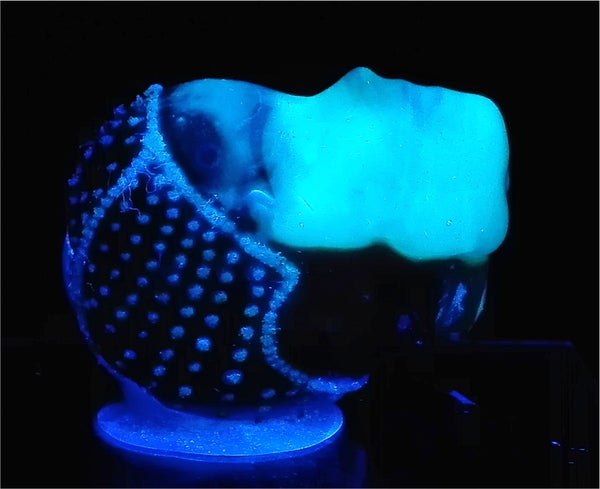
“Living ink” sounds like fantasy from a Harry Potter novel. But it is actually how scientists describe a new 3-D gel laced with bacteria that turn out molecules helpful in wound healing and water cleanup. The material can be customized for different uses by adding a variety of bacteria, and sprayed out of the nozzle of a 3-D printer into many useful shapes.
Although bacteria can cause infections, they are also versatile workhorses. Various types of microbes break down pollutants, synthesize useful compounds and carry out photosynthesis and other metabolic processes. “We thought 3-D printing might be a nice opportunity to structure these bacteria into functional materials,” says Patrick Rühs, a postdoctoral researcher studying complex materials at the Swiss Federal Institute of Technology (E.T.H.) Zurich and an author of a new paper describing the process. It was published today in Science Advances.
He and his colleagues began by designing a hydrogel, a network of polymers that absorbs large amounts of water. Gelatin, for instance, is a hydrogel. The watery structure allows the gel to flow through the nozzle of a 3-D printer but solidify afterward. The team’s hydrogel has two sugar-based polymer ingredients—hyaluronic acid and the seaweed extract carrageenan—to provide structure and to nourish the bacteria. The gel also contains fumed silica, which makes the material more viscous and elastic. After bacteria are added to the gel, the material is sprayed out and forms a stretchy network that holds its printed shape.
On supporting science journalism
If you're enjoying this article, consider supporting our award-winning journalism by subscribing. By purchasing a subscription you are helping to ensure the future of impactful stories about the discoveries and ideas shaping our world today.
One promising application of the new material is customized treatment of wounds and burns. Fed with the nutrients in the gel, along with oxygen, bacteria called Acetobacter xylinum make cellulose, a molecule that speeds healing when placed on the surface of a wound. It makes a good scaffold for skin grafts or engineered tissue. Coating a transplanted organ with cellulose can also reduce the risk of its rejection. For all of these uses, a close fit to a body part is better. A hydrogel containing the bacteria could be used to fabricate cellulose dressings in the exact shape of a body part or organ based on a CT scan, Rühs says.
To test this idea, the researchers made a hydrogel with A. xylinum. Using a 3-D printer than can handle curvy surfaces, they deposited a thin layer of the hydrogel over a doll’s face. After four days in a warm, humid environment the bacteria transformed the hydrogel surface into one made of cellulose. Cellulose is only made on the surface of the hydrogel because that is where most of the oxygen is—therefore, the method produces thin coatings suitable for wound treatment. “This result is the first example of patterned materials produced through 3-D printing of bacteria,” says Anne Meyer, a professor of bionanoscience at Delft University of Technology who was not involved in the study. Her team developed an earlier bacterial hydrogel made with the algae-produced polymer alginate, but did not cast it into functional products.
Similar bacterial materials could help clean the environment. The E.T.H. team made a hydrogel grid incorporating a strain of Pseudomonas putida that breaks down the pollutant phenol. The grid cleaned up a solution of phenol in about six days. This would be a handy setup for bioremediation, Meyer notes, because the bacteria in the grid could be reused or transferred to a new location.
The reusability may have problems, though. When the researchers rinsed the grid and repeated the experiment in a new phenol solution, the cleanup time dropped to a day, most likely because some of the bacteria escaped into solution while more continued to grow in the matrix. This may make cleanup more efficient but it could be less desirable in practice because it could introduce bacteria into the environment, says Jason Shear, a chemist at The University of Texas at Austin who was not part of the work.
The team is still refining the material for real-world testing, Rühs says. Because “living ink” can be made with any kind or combination of bacteria, the researchers are thinking about other applications as well. They want to tackle oil spills by designing a hydrogel with a lipophilic polymer that absorbs oil instead of water, for example. Once it has soaked up the oil, bacteria inside the gel could break the oil down.