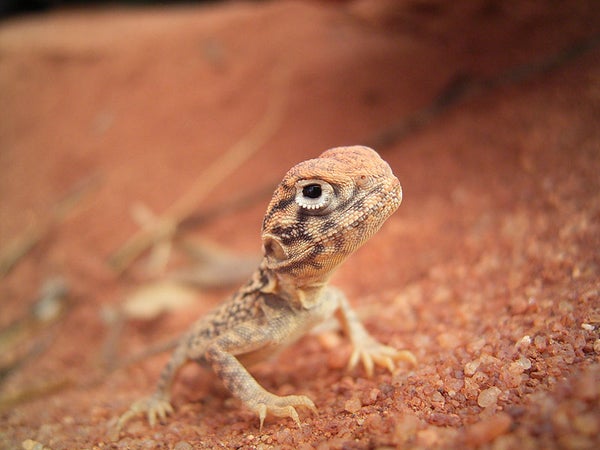
Lizards Pop Wheelies

Lizards running on their two hind legs require no special anatomical tricks, according to a new study; rather the posture is a fluke of biomechanics akin to popping a wheelie.

Courtesy of Christofer Clemente

Join Our Community of Science Lovers!


On supporting science journalism

If you're enjoying this article, consider supporting our award-winning journalism by subscribing. By purchasing a subscription you are helping to ensure the future of impactful stories about the discoveries and ideas shaping our world today.


Lizards running on their two hind legs require no special anatomical tricks, according to a new study; rather the posture is a fluke of biomechanics akin to popping a wheelie. Australian researchers collected specimens of 16 dragon lizard species from the outback and filmed them running flat-out on a treadmill in the lab. Instead of falling neatly into two groups—bipedal runners and quadrupedal scurriers—as the scientists expected, the lizards were highly variable in the amount of time they spent sprinting on two legs—from nearly none to almost all. When researchers drew up an evolutionary tree showing the relationships between lizard species, there was no logical pattern to the variation. Using computer models, they discovered that the peppier the critter's acceleration, the more likely its center of gravity would shift toward the hips and raise the torso like a motorcycle rearing up on its hind wheel. Writing in The Journal of Experimental Biology, the authors say that running in lizards is therefore a natural consequence of acceleration that may have become more prevalent in certain species because it benefited maneuverability—or for reasons still unknown.

It’s Time to Stand Up for Science

If you enjoyed this article, I’d like to ask for your support. Scientific American has served as an advocate for science and industry for 180 years, and right now may be the most critical moment in that two-century history.

I’ve been a Scientific American subscriber since I was 12 years old, and it helped shape the way I look at the world. SciAm always educates and delights me, and inspires a sense of awe for our vast, beautiful universe. I hope it does that for you, too.

If you subscribe to Scientific American, you help ensure that our coverage is centered on meaningful research and discovery; that we have the resources to report on the decisions that threaten labs across the U.S.; and that we support both budding and working scientists at a time when the value of science itself too often goes unrecognized.

In return, you get essential news, captivating podcasts, brilliant infographics, can't-miss newsletters, must-watch videos, challenging games, and the science world's best writing and reporting. You can even gift someone a subscription.

There has never been a more important time for us to stand up and show why science matters. I hope you’ll support us in that mission.

Thank you,

David M. Ewalt, Editor in Chief, Scientific American

Subscribe