
The Archimedes Palimpsest is one of the treasures of antiquity. This medieval manuscript, dating the to the 10th century, includes copies of the writings of Archimedes of Syracuse, a Greek mathematician and scientist who laid the foundations of modern calculus, geometry and fundamental physics. And now scientists have recovered one of the lost pages of the palimpsest, shedding more light on the great scientist’s mathematical thinking.
The page has been missing for years: we know that in 1906 a historian photographed much of the manuscript—but sometime later, some of the pages mysteriously went missing.
Researchers discovered the missing sheet, page 123, in the Museum of Fine Arts in Blois, France, according to the French National Center for Scientific Research (CNRS). One side of the page includes a writing from Archimedes’ treatise On the Sphere and the Cylinder, much of which is legible, according to the CNRS.
On supporting science journalism
If you're enjoying this article, consider supporting our award-winning journalism by subscribing. By purchasing a subscription you are helping to ensure the future of impactful stories about the discoveries and ideas shaping our world today.

© Blois, Musée des Beaux-Arts, Inv. 73.7.52. Photography IRHT-CNRS
The text on the other side of the page is less certain: whatever was written there is covered up by a gilded illustration of the Biblical prophet Daniel. Researchers hope to use x-rays and other advanced imaging methods to uncover the text under the drawing.

© Blois, Musée des Beaux-Arts, Inv. 73.7.52. Photography IRHT-CNRS
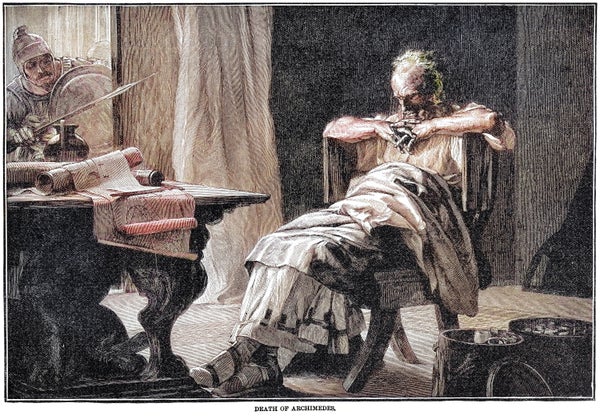
Archimedes lived around 250 B.C.E. in Syracuse in ancient Greece and was among the world’s greatest thinkers, responsible for theories, experiments and inventions about math, physics and engineering that still intrigue scientists today. (Legend has it that Archimedes died doing math—at the hands of a Roman soldier while making a calculation in the sand—though this has never been confirmed.)
The rest of the Archimedes Palimpsest is housed at the Walters Art Museum in Baltimore, Md., although it’s unclear if the missing page will be added to the collection.