
By Ian Simpson
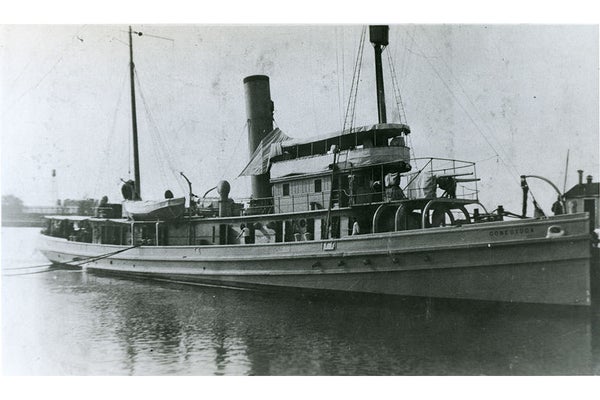
WASHINGTON, March 23 (Reuters) - A U.S. Navy tug missing since 1921 has been discovered sunk off San Francisco, officials said on Wednesday, solving a nearly century-old maritime mystery.
The wreck of the USS Conestoga was found near one of the Farallones Islands about 30 miles (50 km) west of San Francisco, the National Oceanic and Atmospheric Administration and the Navy said in a statement.
On supporting science journalism
If you're enjoying this article, consider supporting our award-winning journalism by subscribing. By purchasing a subscription you are helping to ensure the future of impactful stories about the discoveries and ideas shaping our world today.
"After nearly a century of ambiguity and a profound sense of loss, the Conestoga's disappearance no longer is a mystery," said NOAA Deputy Administrator Manson Brown.

PACIFIC OCEAN (March 23, 2016) The wreck of the U.S. Navy tugboat USS Conestoga is seen on sonar in at a depth of 185 feet in the waters of the Greater Farallones National Marine Sanctuary in California. Conestoga departed San Francisco Bay on March 25, 1921 and vanished with 56 men. The discovery of the wreck solves a 95 year-old mystery.
(U.S. Navy photo courtesy of NOAA/Released)
The ocean-going tug left San Francisco on March 25, 1921, bound for American Samoa via Hawaii with 56 officers and sailors aboard. It was never heard from again, and its disappearance triggered an air and sea search and gripped newspapers across the United States.
The Navy declared Conestoga and its crew lost in June 1921. It was the last Navy ship to be lost without a trace in peacetime, the statement said.
Unraveling the mystery began in 2009, when NOAA found an uncharted likely shipwreck in 189 feet (57.6 meters) of water about three miles (five km) off Southeast Farallon Island, in the Greater Farallones National Marine Sanctuary.
The agency began an investigation in September 2014 and the ship was identified in October 2015.

The officers and crew of USS Conestoga, in San Diego, California in 1921. Lost for 95 years, the tug was discovered in the Greater Farallones National Marine Sanctuary off San Francisco.
Credit: Naval Historical Center Photograph NH 71503
Weather logs show that around the time of Conestoga's departure, the wind in San Francisco's Golden Gate area rose to 40 miles per hour (64 km per hour) and the seas were rough with high waves, the statement said.
A garbled radio transmission from Conestoga relayed by a ship said the tug was "battling a storm and that the barge she was towing had been torn adrift by heavy seas."
Investigators believe that the Conestoga sank as it tried to reach a protected cove on Southeast Farallon Island.
Underwater videos show the wreck lying on the seabed and largely intact. The wood deck and other upper features have collapsed into the hull due to corrosion and age, the statement said.
Marine growth covers the exterior. No human remains have been found.