
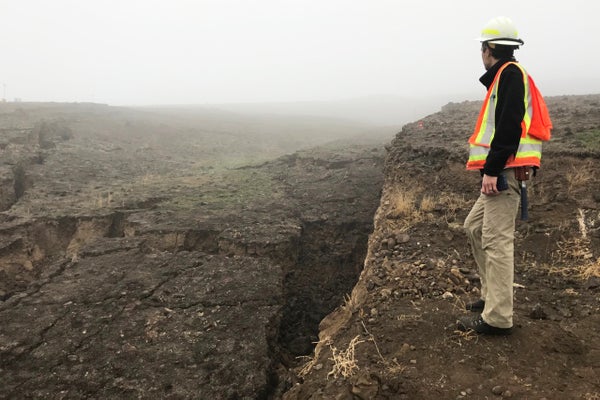
A crack is growing in Rattlesnake Ridge, a red-dusted hilltop near the town of Union Gap in Washington State’s Yakima County.
The fissure is causing a huge amount of ground perched above a small neighborhood to slip down. Since late October four million cubic yards of land have edged down the slope, raising the risk of a landslide. The failure point, geologists think, is approaching in the next weeks or months. So residents have had to make a decision: Do they abandon their homes for safety or risk their lives and stay? The decision is made more difficult by uncertainty about the path. Though the slide is likely to bypass the nearby houses and simply dump into a quarry, if the worst-case scenario occurs, it will slam into the neighborhood, an interstate highway, and the Yakima River.
Even as emergency managers scramble to move people out of harm’s way, geologists are attempting to observe Rattlesnake Ridge to improve their ability to predict disaster. Landslides occur daily around the world and kill thousands of people each year. Many are fast and furious, occurring without much warning. These are usually triggered by natural disasters: In the months since Hurricane Maria ravaged Puerto Rico more than 50,000 landslides occurred across the island, and the rain hitting California’s scorched landscape this past week caused rivers of mud debris and at least 17 deaths. But other slides, like the one threatening Yakima County residents, play out slowly, creeping along for months before they gain speed unexpectedly.
On supporting science journalism
If you're enjoying this article, consider supporting our award-winning journalism by subscribing. By purchasing a subscription you are helping to ensure the future of impactful stories about the discoveries and ideas shaping our world today.
Thus, Rattlesnake Ridge gives scientists a rare opportunity to watch a landslide develop in real time, says David Montgomery, a geomorphologist at the University of Washington. To assess the impending hazard, the Washington State Department of Natural Resources, along with other agencies have placed nearly 70 GPS stations and four seismometers on the slipping slope. They have even been using an airborne laser-scanning technology, known as LiDAR. Geologists would like to use that data to learn details about the landslide’s past movement that might help them forecast how it might behave in the future. And should the slide change behavior—if it shifts direction or picks up speed—experts can recommend on-the-ground decisions, like shutting down the interstate if need be. “From a purely scientific perspective, that’s a really interesting opportunity to try and predict when something like that will happen and see if you get it right,” Montgomery says. At the moment the Rattlesnake Ridge landslide appears to be moving 1.6 feet per week and the rate has been slightly accelerating. But as a rift fails, it evolves, making any prediction difficult.
“We've got a long way to go to be able to predict what any given landslide is going to do,” says William Schulz, a research geologist in the U.S. Geological Survey’s Landslide Hazards Program. That is for the sheer reason that different controlling factors can be hard to tease apart—especially if they lie beneath your feet. Program Coordinator Jonathan Godt notes the subsurface materials are often what control the landslide, and yet the makeup of these materials is often unknown. He wants to determine any links between the strata below and ground motion above. A case study like the one at Rattlesnake Ridge could help scientists better determine that connection. “The more we know and understand, the more that we’ll be able to forecast the behavior when we get into situations like this,” Montgomery says. “That's one of the real values of doing landslide studies.” He adds that such research “can help provide emergency managers with a broader perspective and insight when they’re faced with a situation like this, where they really want to forecast and get the forecast right. But it's tricky business.”
Scientists cannot yet say, for example, what triggered the landslide at Rattlesnake Ridge. Although there is no official conclusion, a few suspect the cause might have been digging in the quarry at the base of the slope. Human actions have helped tilt the scale of gravity down elsewhere. As much as 80 percent of the landslides that occur in the Seattle area for example, have been exacerbated by human activity. Studies have shown timber harvesting, road building and a variety of agricultural processes will trigger a landslide. Gravity will attempt to level any hill over a long period of time, Schulz says, but things people do can certainly speed up the process.
To help provide early warnings about precarious hillsides in the future, the USGS is planning to collect LiDAR data that would allow them to peer beneath vegetation in search of any ground deformation. NASA also plans to launch (pdf) a satellite in 2020 that will allow the agency to identify and track subtle movements of Earth’s surface. “That may revolutionize monitoring landslide activity across the country and the globe,” Godt says. Meanwhile in Yakima County, officials are placing heavy barriers between the major highway and millions of cubic yards of moving rock and earth. Just in case.
