
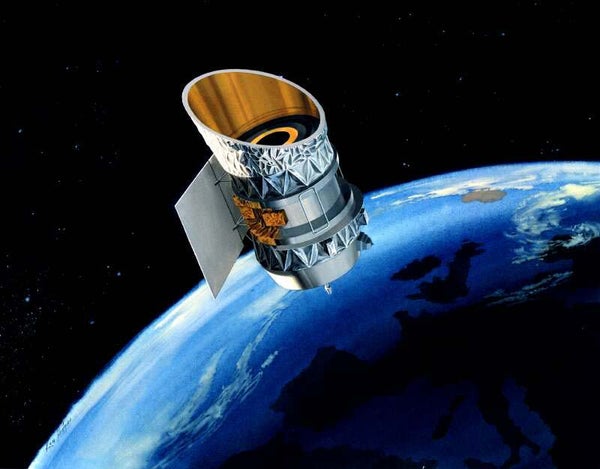
Let's hope that today's close encounter of two old pieces of space junk is just a near miss as predicted, because a smashup would be pretty messy.
Two long-dead satellites — the Infrared Astronomical Satellite (IRAS) and the Gravity Gradient Stabilization Experiment (GGSE-4) — will
whiz past each other this evening (Jan. 29) about 560 miles (900 kilometers) above Pittsburgh, Pennsylvania.
On supporting science journalism
If you're enjoying this article, consider supporting our award-winning journalism by subscribing. By purchasing a subscription you are helping to ensure the future of impactful stories about the discoveries and ideas shaping our world today.
At closest approach, which occurs at 6:39 p.m. EST (2339 GMT), the two defunct craft will be just 43 feet to 285 feet (13 to 87 meters) apart, according to the latest calculations by California-based satellite-tracking company LeoLabs.
Those calculations also peg the probability of a collision between IRAS and GGSE-4 at just 0.1%. ThE low odds are a very good thing, considering that both hunks of metal are traveling at more than 32,000 mph (51,500 km/h).
If the collision happens, "I would expect it to be comparable to, but maybe not quite as bad as, the Iridium-Kosmos collision in 2009," said Jonathan McDowell, an astronomer at the Harvard-Smithsonian Center for Astrophysics who monitors many of the objects circling Earth using publicly available U.S. tracking data.
That February 2009 crash, which involved the operational Iridium 33 communications satellite and the defunct Kosmos-2251 Russian military craft, spawned
1,800 pieces of trackable debris by the following October, as well as many other shards too small to detect from the ground. It's perhaps the most famous space-junk event in history, rivaled only by a notorious 2007 Chinese anti-satellite test and a similar Indian demonstration last year.
"So you would see, maybe not thousands of pieces of trackable debris, but at least hundreds," McDowell told Space.com.
GGSE-4 weighs about 190 lbs. (85 kilograms) — much less than IRAS, which tips the scales at nearly 2,400 lbs. (1,090 kg). (Reports that GGSE-4 weighs just 10 lbs., or 4.5 kg, are based on a mistaken assumption that GGSE-4 is similar to GGSE-1, which was a much simpler satellite, McDowell said.)
Most of the debris spawned by a collision between IRAS and GGSE-4 would likely stay in the more massive satellite's path — a sun-synchronous orbit (SSO), which takes a spacecraft over a planet's poles.
"And that's unfortunate, because sun-synchronous orbit is where everyone wants to be," McDowell said. "So, there's a bunch of satellites in that altitude range and orbit."
These include many weather and
spy satellites, which take advantage of the consistent lighting. (Spacecraft in an SSO pass over a given patch of Earth at the same local solar time each day, meaning that illumination conditions are consistent across observations.)
IRAS' orbit is similar to the Chinese weather satellite that was destroyed in the 2007 test, McDowell added.
"So, there's already a lot of debris in that orbit," he said. "Adding more would not be good."
Even tiny pieces of debris can be satellite killers, given how fast objects move in Earth orbit. So, a few collisions in a heavily trafficked patch of space could theoretically lead to a catastrophic cascade of smashups that significantly reduces access to, and exploitation of, the final frontier — a nightmare scenario known as the Kessler syndrome.
More close calls coming
It's not uncommon for chunks of debris to give satellites a close shave. But it is quite rare for two satellites to whiz so close together, said McDowell, who estimated that such events occur once every two years or so.
But these close calls will occur more often in the future as Earth orbit gets more and more crowded. This crowding is occurring because it's getting cheaper and easier to build and launch spacecraft, and also because a few companies are starting to assemble internet-satellite megaconstellations.
For example, SpaceX has permission to launch 12,000 satellites to low-Earth orbit for its
Starlink broadband network and has filed paperwork for up to 30,000 more craft. To put this into perspective: About 2,000 operational satellites currently circle Earth, and humanity has lofted a mere 9,000 or so since the dawn of the space age in 1957. And SpaceX's plans are not just hypothetical; Elon Musk's company has already launched several 60-satellite Starlink batches.
Active Starlink craft are a far cry from inert derelict satellites, of course; SpaceX's satellites will be able to sense and autonomously maneuver away from potential collisions, Musk has said. (This didn't happen when a Starlink satellite neared Europe's Aeolus Earth-observation satellite last September;
Aeolus performed the evasive action. A paging-system bug prevented Starlink operators from learning that the collision probability had increased enough to warrant a maneuver, SpaceX representatives later said.)
But keeping space open and safe for everyone in such a crowded environment will require some planning and some action, McDowell stressed.
"If we're going to allow this large number of satellites, then we have to require more investment in the tracking and the sort of traffic control of them," he said.
The U.S. Air Force has long done the lion's share of this work. But help is now coming from the commercial sector, as LeoLabs' efforts show. And the company, which was founded in 2016, is poised to make even bigger contributions in the near future; in October, LeoLabs unveiled a
new radar system in New Zealand that's designed to track about 250,000 orbiting objects as small as 0.8 inches (2 centimeters) wide.
No fireworks tonight
To repeat: there probably won't be a collision this evening in the skies over Pittsburgh. And even if the two satellites do slam into each other, folks on the ground won't see much, said David Turnshek, a professor of physics and astronomy at the University of Pittsburgh and director of the school's Allegheny Observatory.
IRAS is a fifth- or sixth-
magnitude object, meaning it's visible to the naked eye under clear, dark skies. Light-polluted Pittsburgh doesn't qualify, though people there can see the satellite with binoculars when the weather cooperates, Turnshek said.
GGSE-4, on the other hand, is completely beyond the reach of skywatchers.
"That thing is invisible," Turnshek told Space.com. "It's too small."
There will be no dramatic fireball in the sky this evening if a collision does occur. The most striking effect that astronomers could see is likely a slight perturbation in the streak of light that traces IRAS' orbit, Turnshek said.
And he and his colleagues may indeed look for that perturbation with a scope at the Allegheny Observatory.
"We would just point it straight up with no tracking, and have the shutter on our camera open for the few minutes right when the collision is supposed to happen," Turnshek said. "I think it would be fun."
IRAS, by the way, was a joint mission involving NASA, the Netherlands and the United Kingdom. The satellite launched in January 1983 to study the cosmos in infrared light and ceased observations 10 months later.
GGSE-4 launched in 1967. And that was a cover name; the satellite's real moniker was POPPY-5B, and it was a U.S. National Reconnaissance Office craft devoted to collecting signals intelligence, McDowell said.
Copyright 2020 Space.com, a Future company. All rights reserved. This material may not be published, broadcast, rewritten or redistributed.