New Issue: Science’s Impossible Questions. Read Now

Here’s what MAHA voters really want from health care policy

A new KFF poll found that voters aligned with the “Make America Healthy Again” movement consider the cost of health care as their top policy priority

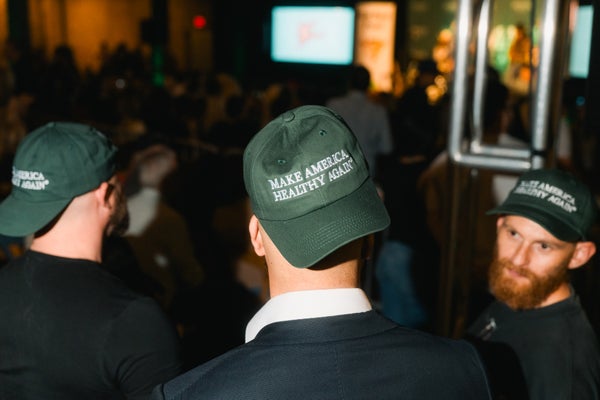
Three men in MAHA hats

Attendees wear “Make America Healthy Again” hats during an “Eat Real Food” rally at Brazos Hall in Austin, Tex., on February 26, 2026.

Jordan Vonderhaar/Bloomberg/Getty Images

Join Our Community of Science Lovers!

“Make America Healthy Again” (MAHA) voters across the political spectrum say lower health care costs are their top policy priority—outranking signature MAHA issues such as vaccine safety and pesticide-free foods—according to a new poll.

The MAHA movement, spearheaded by Secretary of Health Robert F. Kennedy, Jr., promotes policies such as a shifting away from processed foods and encouraging regular exercise. But it has also sparked controversy and criticism from public health experts and doctors because some MAHA figures, including Kennedy, have questioned the science underlying vaccines and the causes of conditions such as autism.

The new poll, released on Wednesday by KFF, asked voters who support the MAHA movement about their top policy priorities. Overall, 42 percent said that “lowering the cost of health care, including prescription drugs,” was their number one issue. Cutting back on “chemical additives in the food supply” came in second, with 21 percent of MAHA voters listing it as their top priority, followed by “reevaluating the safety of vaccines” in the U.S., which was ranked first by 10 percent of MAHA voters.


On supporting science journalism

If you're enjoying this article, consider supporting our award-winning journalism by subscribing. By purchasing a subscription you are helping to ensure the future of impactful stories about the discoveries and ideas shaping our world today.


Stacked bar chart shows how voters who support the “Make America Healthy Again” movement answered the survey question, “Thinking about what the government could do when it comes to health and health care, which of the following is the most important priority to you?” Forty-two percent of respondents chose “Lowering the cost of health care, including prescription drugs,” making that the most common answer by far.

Amanda Montañez; Source: KFF (data)

Interestingly, support for lower health care costs carried across political parties. Just more than half of MAHA voters in the poll were registered Republicans, nearly a third were Independents, and 15 percent were Democrats. But responders from all of these groups, including 57 percent of Democratic MAHA voters and 40 percent of Republican ones, listed health care as their top priority. KFF conducted the survey of more than 1,300 adults in April 2026.

The cost of health care was so important to MAHA voters, in fact, that the majority, 56 percent, said it would have a “major impact” on who they will vote for in the upcoming 2026 midterm election. About half of MAHA voters said it would affect whether they head to the polls at all.

Heath care is expensive—it cost the U.S. nearly $15,000 per person in 2024, according to estimates from the Peterson-KFF Health System Tracker. That’s more than was spent that year by other wealthy countries, including Switzerland (which spent about $10,000 per person), Germany (about $9,400) and the Netherlands (about $8,400), according to the same estimates. Drug prices are also nearly three times higher in the U.S. than in similar countries, according to a 2024 Department of Health and Human Services report.

Jackie Flynn Mogensen is a breaking news reporter at Scientific American. Before joining SciAm, she was a science reporter at Mother Jones, where she received a National Academies Eric and Wendy Schmidt Award for Excellence in Science Communications in 2024. Mogensen holds a master’s degree in environmental communication and a bachelor’s degree in earth sciences from Stanford University. She is based in New York City.

More by Jackie Flynn Mogensen

Subscribe to Support Independent Journalism

Great science journalism requires human expertise, time, effort and creativity. And it costs money. That’s why I and the journalists here at Scientific American hope you’ll join our community.

When you subscribe, you are supporting staff and freelance journalists who are passionate about telling science stories that are true, important and compelling. Our editors and reporters are often experts in their fields, which means they understand the nuances of big discoveries and can untangle the breakthroughs from the hype. With a subscription, you are also supporting rigorous fact-checking to ensure the words we publish are precise and accurate. And you’re supporting original illustrations, graphics and photos that bring you closer to an advanced laboratory, an ice sheet in Antarctica or a space mission in orbit. You’re helping us craft other types of high-quality journalism as well: Our newsletters are carefully written, edited and curated by staffers you have or will come to know and love. Our Science Quickly podcast is based on original reporting, collaboration with editors and scientists and exacting production.

Subscriptions keep this engine running so we can continue to deliver thoughtful, rigorous and independent science journalism to you. In an era of viral misinformation, this work is crucial. If you value what we do, I hope you’ll consider joining us as a subscriber

Thank you,

Jeanna Bryner, Editor in Chief, Scientific American

Subscribe