
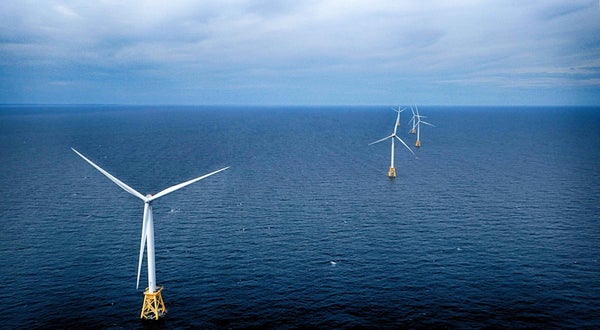
Northeastern states are engaged in a game of renewable one-upmanship.
Early last month, Connecticut Gov. Ned Lamont (D) signed a bill into law calling for 2 gigawatts of offshore wind, or roughly enough to meet a third of the state’s electric demand. New Jersey followed a few weeks later with its first contract for a 1.1-GW project off the coast of the Garden State. The biggest announcement of all arrived last week, when New York announced two contracts worth 1.7 GW of power.
The question is whether all this new wind power will actually be built. Offshore wind is a keystone to the Northeast’s climate goals. Meeting state greenhouse gas emissions targets in the region will be exceedingly difficult without large dollops of wind power generated in the ocean. The new turbines also have the potential to replace a series of old coal, oil and nuclear facilities that have retired in recent years.
On supporting science journalism
If you're enjoying this article, consider supporting our award-winning journalism by subscribing. By purchasing a subscription you are helping to ensure the future of impactful stories about the discoveries and ideas shaping our world today.
But there is cause for caution. Vineyard Wind, the first major offshore project in America, ran into trouble this month when a Massachusetts municipality denied it a key permit needed to run a transmission cable along the ocean floor. But that’s not Vineyard Wind’s sole concern. A federal environmental assessment for the 800-megawatt installation off the coast of Martha’s Vineyard is also expected to take longer than initially anticipated (Energywire, July 15).
Analysts are still bullish on Vineyard Wind’s prospects and the nascent industry as a whole. But they said the hiccup illustrates the challenges of turning state goals into reality.
“This nonstop parade of announcements has created a cheerleading atmosphere that doesn’t reflect reality,” said Anthony Logan, an analyst who tracks the industry at Wood Mackenzie, a consulting firm. “There are a lot of challenges that are popping up and could pop in the future.”
Permitting figures to be one such challenge. Fishing and boating interests have both voiced opposition to offshore projects. Their opposition is likely to grow alongside the size of new wind projects, analysts said.
Then there is the matter of the production tax credit, a federal subsidy for wind, which expires this year. Many of the recently announced projects, like those in New York, are targeting a 2024 start date. They can still qualify for the federal subsidy if they can show they began construction this year, but satisfying the IRS requirements needed to secure that credit will hardly be straightforward.
And then there is the question of the Trump administration. Former Interior Secretary Ryan Zinke was a vocal supporter of the industry, but his successor David Bernhardt’s position toward offshore wind is less clear. Logan described the Trump administration as “a big black box, to some degree.”
The industry still has a lot going for it, not the least of which is the commitment of Northeastern states. New York’s 9-GW target was recently enshrined in state law, following in the steps of New Jersey (3.5 GW) and Massachusetts (3.2 GW).
Cost, too, has not proved the impediment many observers thought it would be. Vineyard Wind beat expectations last year when it signed contracts with Massachusetts to sell its first 400 MW of electricity for $74 per megawatt-hour and its second 400 MW for $65 per MWh (Climatewire, Aug. 6, 2018). New Jersey’s contract with Ørsted A/S, the Danish wind developer, is for $98.10 per MWh.
Vineyard Wind’s lower price is owed in part to the company’s ability to recoup a higher percentage of the production tax credit. The terms of New York’s deals with its two developers, Equinor ASA and Ørsted, were not disclosed.
“Some competitors assumed offshore wind would be too expensive,” said Max Cohen, an analyst at IHS Markit. “It doesn’t seem pricing is the hiccup.”
Finally, there is the size of the developers themselves. Ørsted, for instance, is the largest offshore wind developer in the world, and it now is planning projects in New York, New Jersey, Rhode Island and Maryland. The companies’ deep pockets and experience in Europe will be crucial to launching the industry in America, analysts said.
“This industry has been beaten down and brought up so many times,” said Logan, the Wood Mackenzie analyst. “It’s been a long time in the wilderness. It seems too good to be true, but here we are.”
Reprinted from Climatewire with permission from E&E News. E&E provides daily coverage of essential energy and environmental news at www.eenews.net.

