
Political conservatives become more open to environmentalism after seeing climate change messages rooted in nostalgia, found a new study in the Proceedings of the National Academy of Sciences USA.
Researchers at the University of Cologne in Germany ran several experiments with self-identified liberals and conservatives to evaluate their feelings about environmental conservation, depending on how the issue was presented. For example, participants were given a $0.50 donation to split between two fictional climate change charities: one that emphasized preventing future environmental degradation and one that highlighted reinstating a healthier Earth from yesteryear. In all experiments, conservatives were more willing to embrace environmentalism after confronting climate change messaging that emphasized the past (including donating more to the past-focused charity).
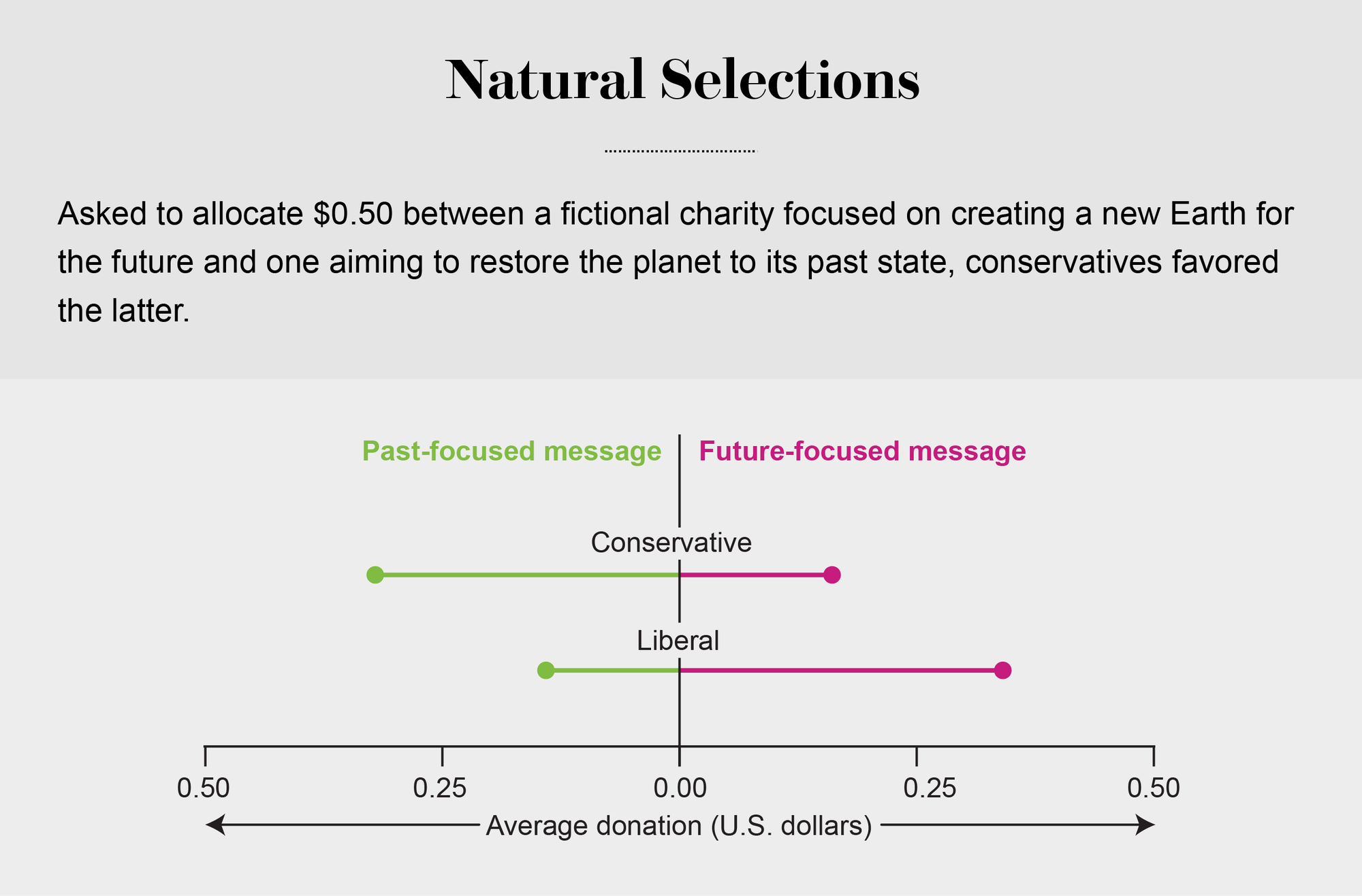
Credit: Amanda Montañez; Source: “Past-Focused Environmental Comparisons Promote Proenvironmental Outcomes for Conservatives,” by Matthew Baldwin and Joris Lammers, in Proceedings of the National Academy of Sciences USA, Vol. 113, No. 52; December 27, 2016
On supporting science journalism
If you're enjoying this article, consider supporting our award-winning journalism by subscribing. By purchasing a subscription you are helping to ensure the future of impactful stories about the discoveries and ideas shaping our world today.
Matthew Baldwin, a co-author on the paper, attributes the findings to the inherent value that conservatives place on the past. For him, the experiments demonstrate the power of framing to change how people respond to information.
Others are skeptical that this insight will lead to change. Riley Dunlap, an environmental sociologist at Oklahoma State University, says the study is well executed, but he doubts that reframing climate change messages can influence conservatives—especially in today's highly polarized political arena. “If you're a good conservative, you need to be a climate change skeptic,” he says. “Global warming has joined God, guns, gays, abortion and taxes. It's part of that ideology.”
Still, Baldwin thinks that approaching climate change as a marketing problem rather than a political issue may be the key to rising above the political quagmire. “If you want to sell a product, you sit down and figure out who your audience is, and you market the product to the audience,” he says. “[My colleagues and I] don't think science is really all that much different.”