
Key concepts
Chemistry
Solids
Liquids
Polymers
Introduction
Kinetic, or “magic,” sand is easy to find in stores, and fun to play with at home! But did you ever wonder what’s so magical about magic sand? You might not be surprised to hear the “magic” is actually science! You can create your own version of this fun mixture with just a few kitchen ingredients.
Background
Kinetic or magic sand is actually just regular sand with one important ingredient added: silicone oil. Silicone is a term used to refer to a group of materials that contain the elements silicon and oxygen. Silicones are polymers, or molecules made up of long chains of repeated units. Silicones are used in everything from hand lotion to car engine oil—they’re all around us! The reason we use silicones so prolifically is because they have some very unique properties, including that they can behave as liquids, semisolids and rubbery solids, depending on the pressure you add. This property is known as viscoelasticity. The degree of viscoelasticity depends on how long the silicone oil's polymer chains are. Longer chains of polymers tend to hold their shapes more effectively than shorter ones do.
On supporting science journalism
If you're enjoying this article, consider supporting our award-winning journalism by subscribing. By purchasing a subscription you are helping to ensure the future of impactful stories about the discoveries and ideas shaping our world today.
In this activity you’ll be exploring the power of polymers by creating and experimenting with your own kinetic dough.
Materials
Two cups of flour
Two to three tablespoons of cooking oil
Two bowls
Fork
Oil- or gel-based food coloring (optional)
Procedure
Measure one cup of flour into each bowl. Set them side by side so you can make comparisons as you work.
If using food coloring, add a few drops to your cooking oil and mix.
Slowly add one tablespoon of cooking oil to one bowl of flour. Use your fork to mix the oil into the flour until the oil is no longer visible and there are no big clumps of flour.
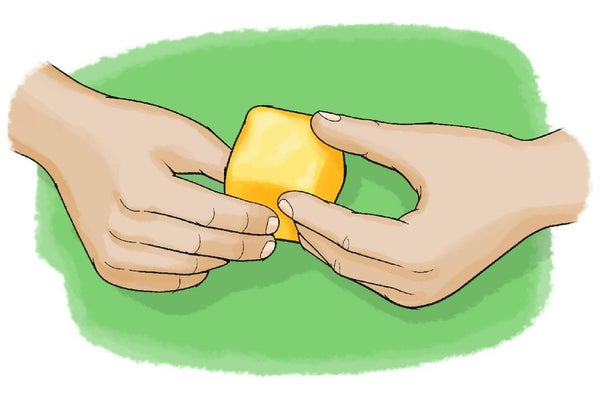
Again, slowly add a second tablespoon of cooking oil to the same bowl of flour. Use your fork to mix the oil into the flour until the oil is no longer visible and there are no big clumps of flour. Use your fingers to blend the flour and oil together. What do you notice about the texture of the flour? Does it stick together? What if you squeeze the flour in your fist?
If the flour does not hold a shape when squeezed, slowly add half of a tablespoon of oil, mix and test your flour again. If it still doesn’t hold a shape, add the remaining oil. Don’t add too much oil! The dough should be dry to the touch. Once the flour is able to hold a shape when squeezed, you have your kinetic dough!
Put your hands in the oil-free flour. Try to mold a shape in the flour by squeezing the it in your fist. What does the flour feel like? Does it hold a shape when you squeeze it? How quickly does it fall apart? Does the flour stick to your hands and the bowl?
Rinse your hands with water and dry them thoroughly. Repeat this step with the kinetic dough. How does the kinetic dough mixture differ from the flour alone? Can you form shapes with the dough? Do you notice that it sticks more or less to your hands than the flour alone?
Extra: With an adult’s help try molding the kinetic dough into shapes and then slicing it with a knife. Test the dough with clay molds or ice cube trays, and see how well you can get your dough to hold its shape.
Observations and results
In this activity you tested adding oil to flour and observed how this simple ingredient changes the behavior of the flour. In doing so you also created your own kinetic dough. This is similar to commercial products such as kinetic sand or magic sand. What is special about all of these substances is the addition of the oil. The kinetic or magic sand you buy at the store is just regular sand that’s been coated with silicone oil. In this activity the cooking oil you added is a polymer just like silicone oil, and it behaves the same way.
With your kinetic dough, the polymer chains in the oil you added made the flour particles stick together so you can form them into a ball that, however, will slowly flatten out over time. In contrast to the flour by itself you should have found you could form shapes with the kinetic dough and that they would stay together fairly well. You should also have noticed the oil and flour mixture stuck best to itself and not as well to other surfaces. This is because the oil polymers like to grab onto one another more than they like to grab onto things like the countertop. As a result, it should have felt less sticky and easier to clean up.
Cleanup
Clean off your work surface with a damp towel, and when finished with flour discard it in trash.
More to explore
Turn Milk Into Plastic!, from Science Buddies
Starchy Science: Creating Your Own Colloid, from Scientific American
Making Mixtures: How Do Colloids Size Up?, from Science Buddies
It's a Solid… It's a Liquid… It’s Oobleck!, from Scientific American
Science Activities for All Ages!, from Science Buddies
This activity brought to you in partnership with Science Buddies
