
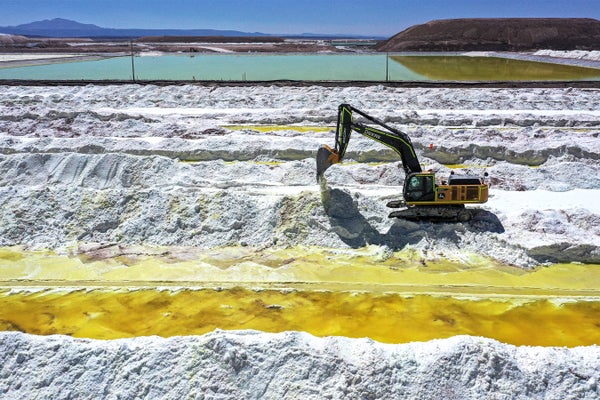
The transition to electric vehicles could lead to lithium shortages unless the United States and other countries overhaul their transportation systems and move away from private cars as the primary means of travel.
Simply converting the existing U.S. car fleet to battery-powered electric vehicles, for example, would require three times more lithium by 2050 than the world currently produces, according to new research from the University of California, Davis, and the Climate and Community Project.
A spike in lithium demand could cause other problems too, such as greater environmental damage and worsening international tension over supplies of the metal, which is primarily mined outside the United States.
On supporting science journalism
If you're enjoying this article, consider supporting our award-winning journalism by subscribing. By purchasing a subscription you are helping to ensure the future of impactful stories about the discoveries and ideas shaping our world today.
The report argues that broader changes in the transportation system, combined with intensive recycling of lithium batteries, could drastically cut into lithium demand. Some suggestions include greater use of mass transit, denser urban development and micromobility solutions such as electric bikes and scooters.
“Any of those changes would be a net positive, all of them would be transformative,” said Thea Riofrancos, a political scientist at Providence College who worked on the report.
The world currently produces a little more than 100,000 tons of lithium a year. Under the base case scenario the researchers established, the United States alone would require 306,000 tons a year by 2050. That assumes the transportation system doesn’t change and consumers buy vehicles with batteries roughly the same size as those used in today’s electric sedans.
In the worst-case scenario — in which the system remains unchanged and battery sizes grow significantly — the United States could consume 483,000 tons of lithium a year by 2050. That would mean that vehicles use as much lithium as Ford’s F-150 Lightning pickup or GM’s recently introduced electric Hummer, which weighs 9,000 pounds and has a battery that’s heavier than some cars (Energywire, Jan. 12).
On the other end of the spectrum, U.S. lithium demand could drop by more than 90 percent from the worst-case scenario by 2050. In addition to greater transit use, micromobility and a shift toward denser communities and options such as walking and biking, that scenario would require smaller car batteries and assumes virtually all batteries are recycled at the end of their life.
The report comes with several caveats that could affect the outcome. Battery companies are looking for ways to squeeze more power out of smaller batteries, for instance, and mining operators around the world are trying to boost production of lithium.
Lithium is critical to making EV batteries but is only produced at one mine in the United States — Silver Peak in Nevada run by Albemarle Corp. (Greenwire, Oct. 14, 2022).
Australia, Chile, China and Argentina account for about 95 percent of the world’s production, the report said.
Globally, demand for lithium is expected to skyrocket by as much as six times the current level, requiring 50 new mines, the International Energy Agency concluded in a report last year.
The Biden administration has made moves recently to shore up the nation’s access to minerals such as lithium, both at home and abroad.
Earlier this month, the Energy Department offered a $700 million conditional loan guarantee for a facility that would process lithium from a mine in southwest Nevada (Greenwire, Jan. 13).
But such projects can be precarious to approve and permit. The Nevada plant, which is still undergoing an environmental review, is facing opposition for its proximity to the only known habitat for the Tiehm's buckwheat, a yellow-tinged wildflower the Fish and Wildlife Service recently listed as endangered (Greenwire, Dec. 14, 2022).
The administration also is looking overseas to shore up supply chains for battery minerals. The United States and allies who comprise the so-called Mineral Security Partnership are vetting 16 projects — from mining to processing and recycling — that will be required to meet high humanitarian and environmental standards (Greenwire, Jan. 23).
Reprinted from E&E News with permission from POLITICO, LLC. Copyright 2023. E&E News provides essential news for energy and environment professionals.
