Map of Antarctica’s Bedrock Reveals Vulnerabilities

A new view of the frozen continent could improve predictions for sea-level rise

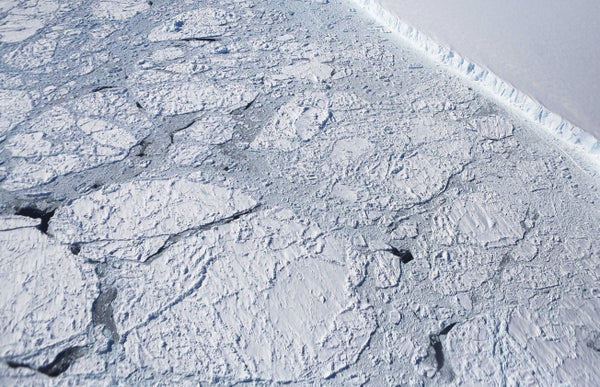
The western edge of the famed iceberg A-68 (top right), calved from the Larsen C ice shelf, is seen from NASA's Operation IceBridge research aircraft, near the coast of the Antarctic Peninsula region, on October 31, 2017, above Antarctica.

Join Our Community of Science Lovers!


On supporting science journalism

If you're enjoying this article, consider supporting our award-winning journalism by subscribing. By purchasing a subscription you are helping to ensure the future of impactful stories about the discoveries and ideas shaping our world today.


Where and how fast will Antarctica lose ice as the climate warms, and how much will the sea level rise as a result? To answer these questions, scientists must learn as much as possible about the vast continent—despite the challenge of accurately surveying its topography underneath all that ice. The contours of Antarctica’s bedrock help determine the behavior of glacial grounding lines, the zones where glacier ice transitions from resting on ground to floating on ocean water; if the line moves inland, a glacier loses more ice. Last December researchers published an upgraded bedrock map in Nature Geoscience, combining measurements from sources that included airborne radar, satellite, seismic and snow accumulation data. The team estimated the topography for gaps between radar measurements using a more accurate, physics-based method, and they found striking differences from older maps—for instance, prior bedrock elevation estimates in some areas were up to 2,000 meters off.

The new map reveals good and bad news about potential ice loss in different parts of the continent. “There is not much hope for West Antarctica,” says Mathieu Morlighem, the study leader and an earth system scientist at the University of California, Irvine. “But East Antarctica is a mixed picture.” The study fills in crucial knowledge gaps about the continent’s bedrock topography, says Jonathan Bamber, a glaciologist at the University of Bristol in England, who was not involved in the map project: “This is going to make our projections and simulations that much better for predicting sea-level rise.”

Credit: Katie Peek; Sources: “Deep Glacial Troughs and Stabilizing Ridges Unveiled beneath the Margins of the Antarctic Ice Sheet,” by Mathieu Morlighem et al., in Nature Geoscience; December 12, 2019

Annie Sneed is a science journalist who has written for the New York Times, Wired, Public Radio International and Fast Company.

More by Annie Sneed
Scientific American Magazine Vol 322 Issue 3This article was published with the title “Mapping the Frozen Continent” in Scientific American Magazine Vol. 322 No. 3 (), p. 23
doi:10.1038/scientificamerican0320-23

It’s Time to Stand Up for Science

If you enjoyed this article, I’d like to ask for your support. Scientific American has served as an advocate for science and industry for 180 years, and right now may be the most critical moment in that two-century history.

I’ve been a Scientific American subscriber since I was 12 years old, and it helped shape the way I look at the world. SciAm always educates and delights me, and inspires a sense of awe for our vast, beautiful universe. I hope it does that for you, too.

If you subscribe to Scientific American, you help ensure that our coverage is centered on meaningful research and discovery; that we have the resources to report on the decisions that threaten labs across the U.S.; and that we support both budding and working scientists at a time when the value of science itself too often goes unrecognized.

In return, you get essential news, captivating podcasts, brilliant infographics, can't-miss newsletters, must-watch videos, challenging games, and the science world's best writing and reporting. You can even gift someone a subscription.

There has never been a more important time for us to stand up and show why science matters. I hope you’ll support us in that mission.

Thank you,

David M. Ewalt, Editor in Chief, Scientific American

Subscribe