
A massive geomagnetic storm stunned Quebec in 1989, triggering blackouts across the province. The storm—a disturbance in Earth's magnetic field caused by a blast of charged particles from the sun—created electric currents that raced through underground power lines and overloaded the grid. Now new research suggests the composition of rock in specific regions could influence the risks from such “superstorms,” which occur about once a century.
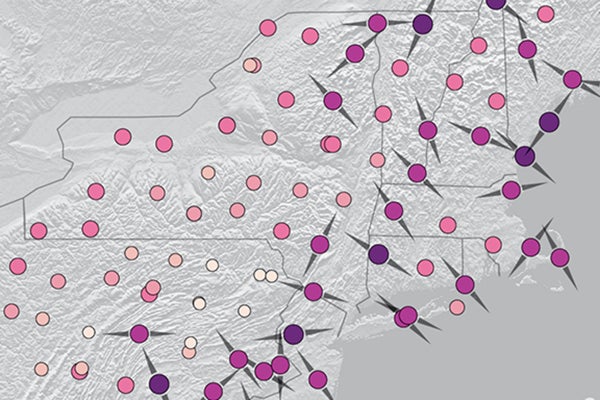
Geomagnetic storms induce a local electric field in the ground, producing current. Geophysicist Jeffrey Love of the U.S. Geological Survey and his colleagues used sensors throughout the U.S. Northeast to determine the maximum electric field such a storm could create. By combining these measurements with storm data, they produced a map identifying areas with a higher chance of blackouts. The results were published in March in Space Weather.

Credit: Pitch Interactive; Source: “Extreme-Value Geoelectric Amplitude and Polarization Across the Northeast United States,” By Jeffrey J. Love et al., in Space Weather, Vol. 17, No. 3; March 2019
On supporting science journalism
If you're enjoying this article, consider supporting our award-winning journalism by subscribing. By purchasing a subscription you are helping to ensure the future of impactful stories about the discoveries and ideas shaping our world today.
They found that the type of rock in an area influences the strength and direction of the electric field a geomagnetic storm can create. If the rock is a good conductor, the resulting current flows easily through the ground. But if the rock is resistive, the current may travel through power lines instead, possibly threatening the grid.
Fields greater than one volt per kilometer can interfere with a grid's operation, and much stronger fields can cause blackouts. The team found that the most hazardous area is in Virginia, where fields can be as strong as 25.44 volts per kilometer during intense magnetic storms. Major cities, including New York, Boston and Washington, D.C., can also experience relatively powerful fields. These areas have metamorphic rock (which has been changed by intense heat or pressure) and igneous rock (lava that has cooled and solidified); both are electrically resistive. Other areas, such as the northwestern Appalachians, have a lot of conductive sedimentary rock, which should have lower geoelectric hazards.
The team says the findings could help communities prepare for future storms, and similar studies are planned elsewhere. “There's a lot of work going on in our industry, with help from the scientific community in various parts of the world,” says David Boteler, a research scientist at Natural Resources Canada, who was not involved in the study. He says power grids are already being designed to handle the next “100-year storm.”