
If you were wondering how many Americans think coal-fired power plants should cap emissions, how much they worry about climate change or even how often they talk about it, well, there’s a map for that.
The Yale Climate Opinion maps, which offer some of the most detailed information available on how people across the U.S. view climate change, just got their first update in two years.
The interactive maps, which hadn’t changed since 2014, use survey data to determine climate change beliefs, risk perception and policy support for climate-related policy at the state and local level.
On supporting science journalism
If you're enjoying this article, consider supporting our award-winning journalism by subscribing. By purchasing a subscription you are helping to ensure the future of impactful stories about the discoveries and ideas shaping our world today.
The update unveiled this week incorporates data gathered after the 2016 election by the Yale Program on Climate Change Communication and George Mason University’s Center for Climate Change Communication.
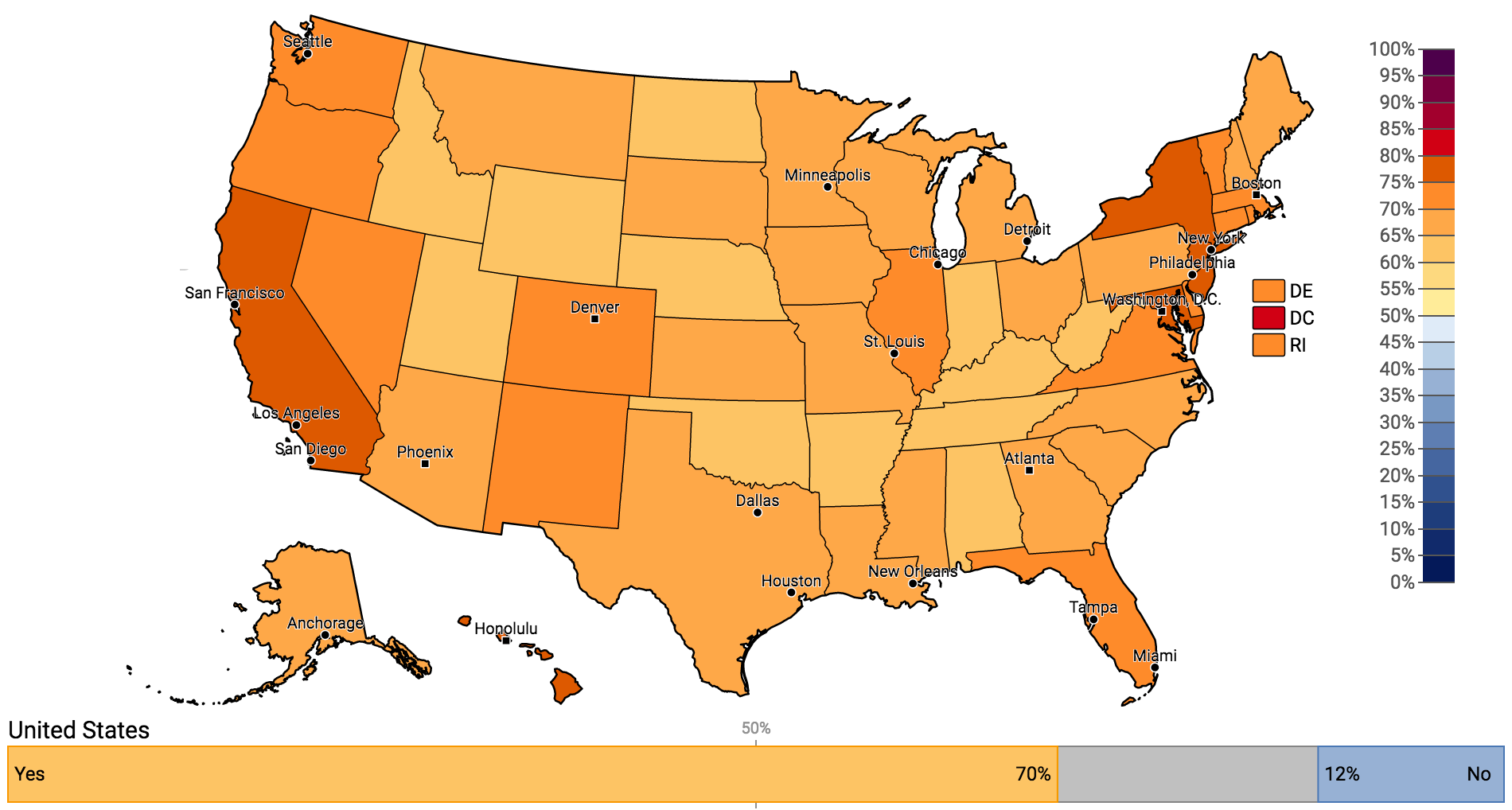
Percentage of adults, by state, who think global warming is happening. Credit: Yale Program on Climate Change Communication, George Mason Center for Climate Change Communication
That polling suggested that Americans have sharply different opinions on climate change than the president. Seven in 10 registered voters say the United States should remain a participant in the international agreement to limit climate change, according to the survey, which polled 1,061 people in the days after the Nov. 8 presidential election. The survey also found that two-thirds of registered voters want the United States to cut its greenhouse gas emissions, regardless of what other countries choose to do (Climatewire, Dec. 13, 2016).
The updated maps show that, across the country, 70 percent of Americans think global warming is happening and that it will harm future generations. An estimated 82 percent of adults think there should be support for research into renewable sources of energy. An estimated 69 percent think there should be strict limits on CO2 emissions from coal-fired power plants.
The changes in the maps allow people to get more specific and see estimates of public opinions in urban areas, said Anthony Leiserowitz, director of the Yale Program on Climate Change Communication.
The new version also adds information from other survey questions, including how much people trust climate scientists, whether they think global warming will harm plants and animals, and how often people discuss global warming with their friends and family. It even asks how often they hear about global warming in the media.
It’s also easier to see how one place might compare with surrounding areas. For example, the map shows that 58 percent of all Americans are worried about global warming. Now, though, the map can identify counties where Americans are more or less worried than that average.
For example, an estimated 57 percent of people in Florida are worried about global warming. In South Florida, though, where the threat is more widely understood because people are experiencing the effects of sea-level rise, an estimated 64 percent of people are worried.
“For the first time, it’s given us a chance for us to see the incredible diversity within the country,” Leiserowitz said. “It’s like a biologist being given a microscope for the first time.”
The public opinion estimates are produced using a statistical model based on national survey data gathered between 2008 and 2016 by Yale and George Mason. Those methods were detailed in a 2015 paper published in Nature Climate Change.
Reprinted from Climatewire with permission from E&E News. E&E provides daily coverage of essential energy and environmental news at www.eenews.net.