
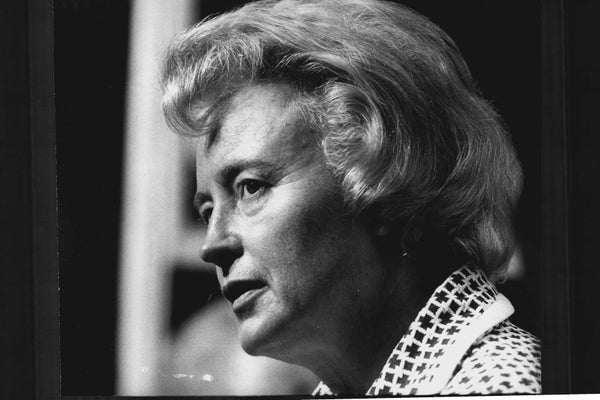
Margaret Burbidge, an astronomer who made vital contributions to our understanding of what happens inside stars and who worked on instruments for the Hubble Space Telescope, has died at 100.
The University of California, San Diego, where Burbidge had worked from 1962 to 1988, announced her death on Twitter Monday (April 6), noting that she had died on Sunday (April 5). Burbidge was most famous for her work establishing how stars produce increasingly heavy elements and distribute them throughout the universe.
In the 1950s, the fact that elements are born in stars had already been established, but the mechanism was unknown. Burbidge led a four-person team that published a 100-page paper outlining the details of the reactions that take place within stars, astronomical observations that supported the idea, and a hypothetical chain of events that would cause stellar explosions that distributed elements across space. A colleague later won the Nobel Prize for the team’s research on these stellar reactions.
On supporting science journalism
If you're enjoying this article, consider supporting our award-winning journalism by subscribing. By purchasing a subscription you are helping to ensure the future of impactful stories about the discoveries and ideas shaping our world today.
“It was the first, and still is, the most important paper that’s ever been written on that subject ... giving you the cookbook of how you make the elements and why,” Mark Thiemens, a chemist at the University of California, San Diego, said in a statement released to commemorate Burbidge’s 100th birthday.
The work led some to nickname Burbidge "Lady Stardust" in recognition of her role discovering how the reactions that take place within stars create the elements all around us.
Burbidge also researched quasars, or supermassive black holes that create high-speed jets, including using data gathered by the Hubble Space Telescope on such objects. She encouraged the construction of Hubble, including working on the Faint Object Spectrograph, which spent seven years observing in space.
Like many other female astronomers conducting research in the 20th century, Burbidge had to break through systemic obstacles to her work. At one point, she gained access to a premier observing facility by pretending to be an assistant to her husband, who was also an astronomer and who collaborated on her stellar chemistry work.
Later in her career, she declined a prominent award for women in astronomy, writing, “It is high time that discrimination in favor of, as well as against, women in professional life be removed.”
Born in 1919, Burbidge grew up in the U.K., fell in love with the night sky as a child, and worked in her father’s chemistry lab.
When she saw a spiral galaxy for the first time, according to astrophysicist Andreea Font of Liverpool John Moores University commemorating Burbidge’s centenary in The Conversation, she wrote: “I felt it was almost sinful to be enjoying astronomy so much, now that it was my job and the source of my livelihood.”
Copyright 2020 Space.com, a Future company. All rights reserved. This material may not be published, broadcast, rewritten or redistributed.