
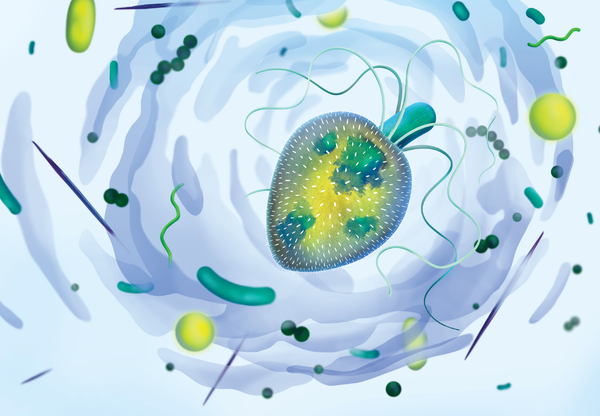
Ocean oddities called mixoplankton are organisms that can get energy both through photosynthesis and by eating other microbes. Now new research published in Nature Communications suggests that one such species, Prorocentrum cf. balticum, displays a bizarre and clever hunting technique—one that significantly contributes to the crucial cycling of carbon through land, atmosphere and oceans.
Study lead author Michaela Larsson, a marine biologist at the University of Technology Sydney, and her colleagues were studying marine mixoplankton in the laboratory when they noticed the creatures twisting and turning as they exuded mucus. The researchers found that beyond photosynthesizing in the daytime, these organisms also form a carbon-rich “mucosphere” around themselves at night—then use chemical cues to lure other microbes into it. The mixoplankton then eat the microbes and shed the mucus package, which sinks to the ocean floor and deposits a rich store of carbon.
The study “is evidence that our thinking around how carbon is cycled in the ocean must be revised to include the sophisticated behaviors of microbes,” Larsson says. Identifying P. balticum DNA in a global marine microbe data set shows the organisms' prevalence across the ocean, suggesting they contribute considerably to the planetary carbon cycle. The authors estimate these plankton could sequester up to 0.15 gigaton of carbon every year—about 0.5 percent of the world's annual carbon emissions.
On supporting science journalism
If you're enjoying this article, consider supporting our award-winning journalism by subscribing. By purchasing a subscription you are helping to ensure the future of impactful stories about the discoveries and ideas shaping our world today.
According to Aditee Mitra, a marine systems modeler at Cardiff University in Wales, who was not involved in the research, the paper “is yet another indication of how little we know about [ocean] organisms that collectively have generated around half of the oxygen in Earth's atmosphere and continue to play a pivotal role in planetary biogeochemical cycling.”
Since the study's publication, scientists have observed that other mixoplankton species can form and release mucospheres. Researchers are also investigating how microbe behaviors might vary in different marine conditions. “Discovering this microbial behavior and evaluating the broader implications for ocean biogeochemical cycling really are just the beginning,” Larsson says.